 UAE Trusted
Managing Banking Operations Across Multiple Business Entities in the UAE
Running mainland, free zone, holding and subsidiary companies means juggling many bank accounts. Discover how to bring structure, control and unified visibility to banking across every business entity in the UAE.

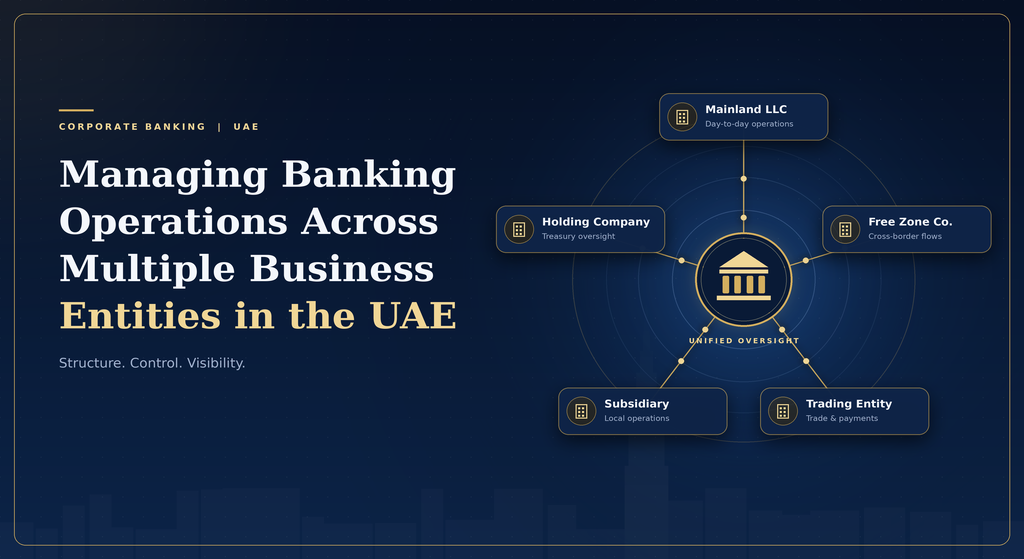
A company with one entity and one bank account can see its finances on a single screen. A group with several subsidiaries, a few branches and payment approvers in different offices cannot. Each new entity adds its own accounts, signatories, currencies and reporting needs. Information that once sat in one place ends up spread across bank portals, spreadsheets and email threads.
At that point, business banking for large corporates is less about individual accounts and more about coordination. Visibility over balances, clear transaction controls and consistent reporting matter more with every entity added. This article covers the operational problems multi-entity businesses commonly face and the practical considerations finance teams can use when reviewing their arrangements.
Why Banking Operations Become More Complex as Businesses Expand
Growth rarely happens in a straight line. A company opens a branch, sets up a subsidiary for a new market, or acquires a smaller business with its own banking relationships. Each step is sensible on its own. Together they produce a structure no one designed as a whole.
Several things change at once:
- More accounts, owned by more people. Balances and activity are managed in different teams, sometimes in different cities.
- Higher transaction volumes. Supplier payments, payroll and inter-company transfers multiply, and so does the chance of a delayed or duplicated payment.
- Fragmented information. Each entity may keep its own records, so building a group-wide picture means manual consolidation.
An arrangement that suits a small company often struggles under this load. One owner approving every payment from a single portal is workable at low volume. Across several entities, it creates bottlenecks, key-person risk and weak oversight. Banking operations for large businesses need structure that does not depend on any one person’s memory or availability.
Key Banking Challenges for Companies Managing Multiple Entities
Cash Visibility Across Business Entities
Finance teams often cannot answer a simple question quickly: how much cash does the group hold today, and where? Balances sit in different accounts, sometimes with different banks, and each source updates on its own schedule.
Suppose one subsidiary holds surplus funds while another delays supplier payments because it is short of cash. If no one sees both positions, the group may borrow or stall payments unnecessarily. Poor visibility makes planning harder and slows decisions that depend on current balances.
Payment Approvals and Transaction Controls
Controls tend to drift apart as entities are added. One entity may need two approvers for large payments while another lets a single person release funds. A bank-side approval setup may no longer match what the company’s internal policy says.
The issue here is not designing an approval workflow, which is an internal process question. It is making sure the limits and approval levels configured with the bank are consistent across entities and still reflect what the group intends. Gaps usually appear where an entity was set up in a hurry or inherited through an acquisition.
Managing Authorised Signatories and Account Access
People change roles, leave the business or move between entities. If signatory lists and online access rights are not updated, former employees or staff in new roles may retain access they should not have.
The risk grows with the number of entities, because each has its own mandate and user list. Without one view of who can do what and where, an access review turns into a slow, manual exercise that tends to be postponed.
Coordinating Domestic and International Payments
Groups with cross-border activity juggle local payments, international transfers and foreign-currency requirements. Different entities may follow different practices. One pays suppliers abroad through a particular route, while another handles similar payments differently.
That inconsistency can mean uneven charges, unclear payment tracking and extra effort when reconciling. Where a group trades internationally, the relevant trade finance options may also bear on how payments and documentation are organised.
Consolidating Financial Information for Reporting
Group reporting depends on getting bank data from every entity in a usable form. When statements arrive in different formats and at different times, finance teams spend their time collecting and cleaning data instead of analysing it.
Month-end becomes slower, and discrepancies are harder to trace. The more entities involved, the more a reporting delay in one of them holds up the whole group.
Practical Ways to Improve Banking Coordination Across a Corporate Group
None of these approaches is a guaranteed fix, and what is available depends on each company’s banking arrangements and the policies of the banks involved. They are starting points for discussion.
Aim for centralised visibility where it makes sense.
Some groups bring balances and activity into a single consolidated view, through a bank’s reporting tools or their own finance systems. Even a simple daily or weekly cash position report can help, provided it is reliable and consistently produced.
Set clear payment approval policies.
Define who can approve what, at which thresholds, and apply the same logic across entities, with exceptions documented. Separating the people who request, approve and release payments reduces the chance of error or misuse. For the process side, see our guide to the finance approval workflow in the UAE.
Keep documentation consistent and review access regularly.
Maintain an up-to-date record of signatories, mandates and user permissions for every entity. Scheduled reviews, and a check whenever someone changes role, help catch outdated access before it becomes a problem.
Coordinate banking requirements across entities.
Before each entity negotiates its own arrangements, it helps to understand what the group needs overall. That covers transaction volumes, currencies, reporting formats and approval structures. Shared requirements can make conversations with banks more focused.
Standardise reporting and review costs
Agree on common reporting formats and timing across entities. Review banking charges and account conditions periodically, since arrangements set up years ago may no longer match current activity.
What to Evaluate When Reviewing Corporate Banking Arrangements in the UAE
When a group reviews its setup, these areas are a useful checklist:
- Transaction capacity and payment requirements: whether current arrangements handle your payment volumes and types.
- Account access and approval controls: how user roles, approval levels and limits can be configured and aligned across entities.
- International payment and foreign-currency needs: which currencies and cross-border payment routes your operations rely on.
- Reporting and account management: what statements, reports and support are available, and how well they suit group-level reporting.
- Banking charges and minimum balance conditions: how fees and balance requirements apply across entities.
- Documentation, compliance and entity-specific requirements: what each entity must provide, since requirements can differ by structure and jurisdiction.
Requirements vary with business structure, transaction profile and financial institution. A company comparing corporate banking services in Dubai or elsewhere in the UAE should confirm specifics directly with each bank. For a broader view of the services corporate banking can include, our guide to business banking for large corporates is a good companion read.
When Should a Business Review Its Existing Banking Structure?
A review is worth considering when something material changes, such as:
- Setting up a new subsidiary or branch, or acquiring a business with existing banking arrangements.
- Expanding internationally, which brings new currencies, payment routes and documentation.
- Rising payment volumes that strain current approval processes or create delays.
- Reporting difficulties, such as slow month-end closes or repeated reconciliation problems.
- Changes to internal financial controls, including new approval policies or a change of finance leadership.
Many groups also schedule a periodic review, for example once a year, whether or not anything has gone wrong.
How Corporate Banking Support Can Help Businesses Review Their Requirements
Prolific Biz Group is an advisory firm, not a bank or a lender. We do not provide banking facilities or make credit decisions. Our role is to help businesses understand and organise their banking requirements.
For companies reviewing their setup, our corporate banking advisory and documentation support can help with clarifying what the business needs from its banking, preparing the documents banks typically ask for, and assessing the options that suit the company’s structure. Our corporate bank account services in Dubai also include multi-currency account support for businesses trading internationally.
Outcomes depend on the company’s profile, its documentation and each bank’s own policies, so we cannot guarantee account opening, approvals or timelines.
Conclusion
For groups with several entities, four things matter most: knowing where cash sits, coordinating how accounts are structured, keeping transaction controls consistent, and producing reporting finance teams can rely on. None of this has to be solved at once. Many groups start by documenting who has access to what and by agreeing on a regular cash position report.
If your business is reviewing its banking setup, you can explore our corporate banking support in the UAE, or get in touch to discuss your requirements.
Disclaimer
This article is intended for general educational and informational purposes only. It provides general insights into corporate banking operations and banking arrangements for businesses in the UAE and should not be considered financial, legal, or banking advice. Banking requirements, services, fees, documentation, and approval processes may vary depending on the business structure and the policies of individual financial institutions. Businesses should verify the relevant requirements directly with their chosen bank or a qualified professional before making decisions. Prolific Biz Group is an advisory firm and does not guarantee account opening, approvals, or banking facilities.
Frequently Asked Questions
What challenges do businesses face when managing banking across multiple entities?
The most common are limited cash visibility, inconsistent approval controls, outdated signatory and access lists, uneven handling of international payments, and slow consolidation of bank data for reporting.
How can a corporate group improve visibility over its business accounts?
Many groups start with a regular consolidated cash position report. Some also use bank reporting tools or finance systems to bring balances together. What is available depends on the bank and the account arrangements.
What banking controls should companies review as they expand?
Approval levels and payment limits, authorised signatories, online user permissions and the separation between those who request, approve and release payments. It helps to check these are consistent across entities.
What should businesses evaluate when reviewing corporate banking arrangements in the UAE?
Transaction capacity, access and approval controls, international payment needs, reporting capabilities, charges and balance conditions, and the documentation required for each entity. Requirements vary by structure and bank.
When should a company review its existing banking setup?
Typically after a significant change, such as a new subsidiary, international expansion, higher payment volumes, reporting problems or revised internal controls. A periodic review is also good practice.