 UAE Trusted

UAE SME Financing in 2026: What Banks Look for Before Approving Business Loans
Learn what UAE banks may look for before approving SME financing in 2026, including financial performance, cash flow, credit history, banking history, documentation, and repayment capacity.

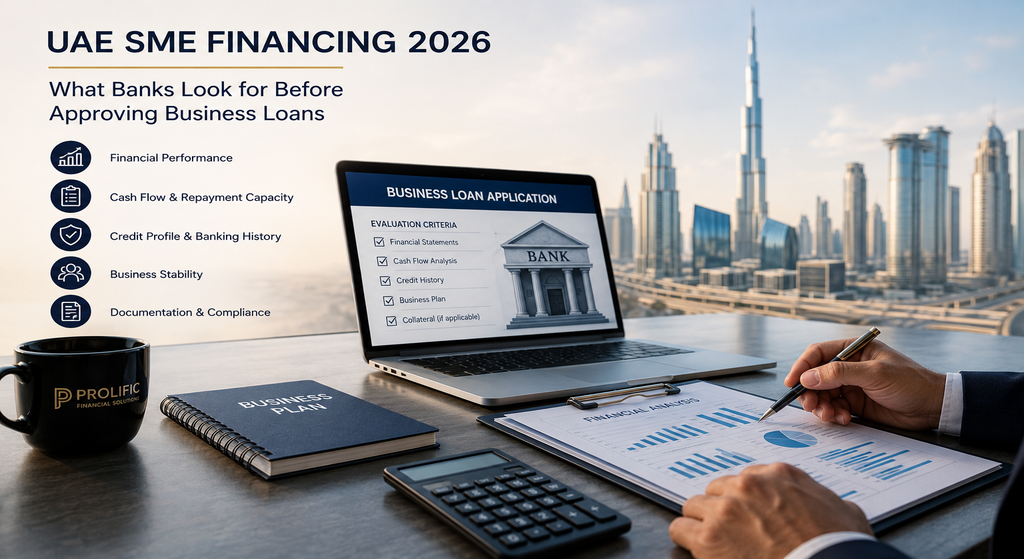
Access to business finance can play an important role in the growth of small and medium-sized enterprises (SMEs) in the UAE. Whether a company needs additional working capital, wants to expand operations, purchase equipment, manage cash flow or invest in a new opportunity, financing can provide businesses with the resources they need at the right stage of growth.
However, getting business financing is not simply about submitting an application and waiting for approval.Banks and financial institutions need to understand the business behind the funding request. Before approving financing, lenders may assess the company’s financial position, business activity, banking behaviour, repayment capacity, ownership structure, documentation and overall credit profile.
For UAE SMEs planning to seek financing in 2026, understanding these factors can help business owners prepare more effectively and identify potential weaknesses before approaching a lender. This guide explains the major factors banks may consider when reviewing an SME financing application in the UAE and how businesses can prepare for the process.
Why SME Financing Matters for UAE Businesses
Small and medium-sized businesses operate across almost every major sector of the UAE economy. As companies grow, they may require additional funds for different reasons. A business may need working capital to manage the gap between receiving customer payments and paying suppliers.
Another company may need financing to purchase equipment, expand operations, increase inventory or open a new location. Financing can also help businesses take advantage of opportunities that require investment before the expected returns are received.
However, borrowing should not be viewed simply as a source of additional cash. Business finance creates a financial obligation. The company needs to understand how the facility fits into its cash flow and how repayments will be managed.
This is one reason why lenders look closely at the financial health of an applicant before approving financing.
What Do Banks Look for Before Approving SME Financing?
Every lender has its own eligibility criteria, internal risk policies and assessment process. There is no single checklist that guarantees approval.
However, several areas are commonly important when a financial institution evaluates a business financing application.
These may include:
- Business financial performance
- Cash flow and repayment capacity
- Company banking history
- Credit profile
- Business stability
- Nature and purpose of the financing
- Company ownership and legal structure
- Quality of financial records
- Existing financial obligations
- Supporting documentation
- Security or collateral, where applicable
- Overall business and credit risk
Understanding these factors can help SMEs prepare more effectively before approaching a lender.
1. The Bank Wants to Understand Your Business
Before considering the financial side of an application, a lender needs to understand what the business actually does. This can include the company’s industry, products or services, customer base, operating model and source of revenue.
A company with a clear and understandable business model can generally present its financing requirement more effectively than a business that cannot clearly explain how it generates income.
Business owners should therefore be prepared to answer basic questions such as:
- What does the company do?
- Who are its customers?
- How does the company generate revenue?
- How long has the business been operating?
- What markets does it serve?
- What are its main operating expenses?
- Why does the business require financing?
- How will the financing support the company?
These questions may appear straightforward, but they form an important part of understanding the applicant.
A business owner should be able to explain the company clearly without relying on complicated financial terminology.
2. Financial Statements Can Influence the Financing Decision
Financial statements provide a lender with a picture of how the business is performing. Depending on the type of financing and lender requirements, businesses may be asked to provide financial information such as profit and loss statements, balance sheets, cash-flow information or audited financial statements.
The purpose is not simply to look at sales. Lenders may want to understand the overall financial position of the company.
Revenue Performance
The lender may review whether the company has a consistent source of income and whether its business activity appears stable.
Profitability
A business may generate significant sales but still have weak profitability because of high operating costs. Profitability provides a different view of the company’s financial health.
Assets and Liabilities
The balance sheet can help show what the company owns and what it owes.
Cash Flow
Cash flow can be particularly important because loan repayment depends on the business having sufficient funds to meet its obligations.
Well-organised financial statements can make it easier for a lender to understand the company’s financial position.
3. Cash Flow Is More Important Than Many Business Owners Realise
A business can be profitable on paper and still experience cash-flow pressure. For example, a company may invoice customers but receive payments at a later date. During that period, the business may still need to pay employees, suppliers, rent and other operating expenses.
This creates a difference between accounting profit and actual cash availability. Lenders therefore have an interest in understanding whether the business generates enough cash to manage its existing obligations and any proposed financing. For SMEs, understanding cash flow before applying for financing is essential.
Business owners should know:
- How much cash enters the business regularly
- When customers normally pay
- What major expenses are due
- Whether payments are seasonal
- What existing financing obligations exist
- How much free cash remains after normal operating expenses
A realistic cash-flow forecast can help a business understand whether additional financing is appropriate and how repayments could fit into its operations.
4. Your Business Bank Account History Matters
The company’s banking activity can provide useful information about how the business operates financially. Banks may review business bank statements and account activity as part of their assessment process.
For example, lenders may want to understand the regular flow of business income, outgoing payments and general account behaviour. Requirements vary between lenders and financing products, but recent business bank statements are commonly requested as part of SME financing applications.
A business should therefore avoid treating its bank account as an afterthought. Consistent and transparent business banking activity can make it easier to demonstrate how the company operates. Businesses should also maintain proper records supporting significant payments and be prepared to explain unusual or significant transactions where required.
5. Credit History Can Affect the Application
Credit history is another important part of the lending process. Financial institutions need to assess whether an applicant has demonstrated responsible financial behaviour.
For business owners, this means existing financial commitments should not be ignored before submitting a new financing application.
A company should have a clear understanding of:
- Existing loans
- Credit facilities
- Outstanding obligations
- Payment history
- Other financial commitments
- Any overdue amounts
Businesses should also ensure that information submitted to the lender is accurate and consistent.
A strong financial record does not guarantee approval, but poor financial behaviour can create additional concerns during the assessment.
6. The Purpose of the Financing Matters
Banks generally want to understand why the business needs financing. There is a major difference between requesting financing for a clearly defined business purpose and requesting money without a clear explanation of how it will be used.
A business financing request might support:
- Working capital
- Equipment purchases
- Business expansion
- Inventory
- Commercial property
- Vehicles
- Technology investment
- Business development
- Other operational requirements
The purpose of financing should make sense in relation to the company’s business model. For example, a company requesting financing for expansion should be able to explain what it plans to expand, why the investment is needed and how the expansion fits into its business strategy.
A clear financing purpose can make the overall application easier for a lender to understand.
7. The Bank May Look at the Company’s Age and Stability
Business history can also be relevant. A company with an established operating history may have more financial information available for assessment than a newly established company.
This does not mean that newer businesses can never obtain financing. However, newer companies may have less historical financial information available, which can make the assessment different.
Depending on the lender and financing product, factors may include:
- Length of business operations
- Revenue history
- Customer relationships
- Banking history
- Financial performance
- Industry experience
- Ownership and management experience
For entrepreneurs, this highlights why maintaining proper financial records from the beginning is valuable.
8. Company Documents Need to Be in Order
Documentation is one of the simplest areas for a business to prepare, yet incomplete documentation can slow down a financing application.
Depending on the lender and financing product, businesses may be asked for documents such as:
- Valid trade licence
- Company incorporation documents
- Memorandum or Articles of Association
- Shareholder information
- Passport and identification documents
- Emirates ID, where applicable
- Power of Attorney or board documents, where relevant
- Bank statements
- Financial statements
- Documents supporting the financing purpose
Requirements vary between financial institutions and products. Businesses should always confirm the current document requirements with the relevant lender.
Keeping company records updated can make the application process more organised and reduce avoidable delays.
9. Existing Debt and Financial Commitments
Before approving new financing, a lender needs to understand the company’s existing financial commitments.
A business may already have:
- Bank loans
- Credit facilities
- Vehicle finance
- Supplier obligations
- Lease commitments
- Other business financing
The existence of existing obligations does not automatically prevent a business from obtaining additional financing. The important issue is whether the company can reasonably manage its overall financial commitments.
Business owners should therefore calculate their current obligations before applying for additional financing. This can help them understand how much additional financing the business can realistically manage.
10. Collateral May Be Relevant for Some Financing
Not every form of SME financing works in the same way. Some financing products may require security or collateral, while others may be structured differently. Where collateral is involved, the lender may evaluate the asset, ownership documentation and other relevant information.For example, secured business financing can involve property or another acceptable form of security.
Business owners should therefore understand whether the financing they are considering is secured or unsecured and what obligations may arise from providing security. Collateral should not be viewed as the only factor determining whether financing will be approved. The borrower’s overall financial ability remains important.
11. Business Ownership and Structure Can Matter
The legal structure of a company can affect the documentation and assessment process. UAE businesses can operate through different structures, including mainland companies, free zone companies, branches and other forms of business establishment.
Banks may request company formation documents and information about shareholders, partners, directors or authorised signatories. This information helps the financial institution understand who owns and controls the business.
Businesses should therefore make sure that their corporate records are current. Changes in ownership, management, company activity or authorised signatories should be properly reflected in relevant documentation.
12. The Industry You Operate In Can Influence Risk Assessment
Different industries have different financial characteristics. Some businesses have predictable recurring income, while others may experience seasonal fluctuations. Some industries require significant inventory, while others operate mainly through professional services.
Some businesses depend heavily on a small number of customers, while others have a broad customer base. A lender may consider these characteristics when evaluating the overall risk associated with an application.
This is why business owners should be able to explain the specific characteristics of their industry.If the business experiences seasonal income, for example, it can be useful to explain the pattern rather than leaving unusual account activity unexplained.
13. Your Business Plan Should Make Sense
A formal business plan is not always required for every financing product, but having a clear plan can help the business owner communicate the purpose of the financing.
A useful financing plan should answer:
Why is the business seeking financing?
How will the money be used?
What business outcome is expected?
How will the business manage repayment?
What happens if the expected growth takes longer than planned?
These questions encourage the business owner to think beyond the immediate need for cash.
For example, borrowing money to increase inventory should be connected to a realistic sales plan.
Similarly, financing a new location should be supported by research into expected demand, operating costs and available cash flow.
14. Banks Look at the Whole Financial Picture
One of the most important points for SMEs to understand is that financing approval is rarely based on one single factor. A business may have strong revenue but weak cash flow. Another business may have good cash flow but insufficient documentation.
Another may have valuable assets but significant existing financial obligations. Therefore, lenders generally need to consider the overall financial picture.
For business owners, this means preparation should also be comprehensive. The objective is not to make the business appear stronger than it is. Instead, the objective should be to present an accurate, transparent and organised picture of the business.
How SMEs Can Prepare Before Applying for Financing
A financing application should ideally begin before the application form is submitted. Businesses can prepare by conducting an internal financial review.
Review Your Accounts
Make sure your financial statements are updated and consistent with your business records.
Check Your Bank Statements
Review recent business banking activity and identify any unusual or unexplained transactions.
Organise Documents
Create a folder containing company documents, financial statements, bank statements and other relevant records. Understand current loans, facilities and other financial obligations.
Define the Financing Requirement
Know exactly why the business needs financing and how the funds will be used.
Prepare a Cash-Flow Forecast
Estimate expected income and expenses so that you understand how repayments could fit into the business’s finances.
Review Your Credit Position
Check whether there are outstanding or overdue financial obligations that need attention.
Prepare to Explain Your Business
Be ready to clearly describe the company’s activities, customers, financial performance and growth plans.
Common Reasons SME Financing Applications Can Face Challenges
There is no single reason why a bank may decline or delay a financing application. However, businesses can reduce avoidable problems by addressing common weaknesses before applying.
Incomplete Documentation
Missing company or financial documents can create delays.
Unclear Financing Purpose
If the business cannot explain why it needs financing, the application may be more difficult to assess.
Weak Financial Records
Incomplete bookkeeping can make it harder to demonstrate the company’s financial position.
Unstable Cash Flow
Irregular or insufficient cash flow can raise questions about repayment capacity.
Existing Financial Pressure
High existing obligations may affect the business’s ability to take on additional commitments.
Inconsistent Information
Differences between financial statements, bank activity and information provided in the application can require further clarification.
Poor Credit History
Past repayment problems may affect the lender’s assessment of the application. These issues do not necessarily mean that a business can never obtain financing. They simply highlight areas that should be reviewed before applying.
Should an SME Apply to Multiple Banks?
Business owners often compare financing options from different financial institutions.
This can be useful because lenders may offer different products, eligibility criteria and financing structures.
However, businesses should compare financing based on more than the headline amount available.
Consider factors such as:
- Financing structure
- Repayment schedule
- Total cost
- Security requirements
- Processing requirements
- Flexibility
- Early repayment conditions
- Business eligibility
- Documentation requirements
- Relationship and service support
The cheapest-looking option is not necessarily the most appropriate option for every business. The right financing should fit the company’s actual financial situation and business objective.
Digital Banking Is Changing the SME Financing Experience
The UAE banking sector continues to invest in digital business banking. For SMEs, this can make some banking processes more convenient, including account management, document submission and application processes. Several UAE banks now offer digital business banking journeys and online application processes.
However, digital processing does not remove the need for financial preparation. A faster application process still requires accurate information. Technology can make submission easier, but it does not replace the underlying financial assessment.
What Is Changing for SMEs in the UAE in 2026?
The UAE’s financial regulatory environment continues to evolve. The Central Bank of the UAE has introduced the SME Customer Protection Regulation, which is scheduled to come into force on 13 September 2026.
The regulation is intended to strengthen the framework for SME customers and establish requirements for financial institutions when dealing with SMEs. For businesses, the broader direction is important.
SMEs should continue to expect financing processes to focus on responsible lending, transparency, customer information and assessment of repayment ability. For business owners, this reinforces the importance of being financially prepared before approaching a bank or financial institution.
How Prolific Can Help UAE SMEs With Financing Preparation
Preparing for business financing can be time-consuming, particularly when a business owner is managing day-to-day operations at the same time.
At Prolific Enterprises FZE LLC, we assist businesses in understanding their financing requirements and preparing for discussions with financial institutions.
Our business finance support can include assistance with:
- Understanding different business financing options
- Reviewing basic financing eligibility requirements
- Preparing and organising required documentation
- Understanding funding requirements
- Supporting business loan and financing applications
- Exploring working capital and equipment financing options
- Assisting SMEs in presenting their business and financing requirements clearly
Every financing application is subject to the lender’s eligibility criteria, internal assessment and final approval. Our role is to help businesses approach the process in a more organised and informed manner.
What Banks Ultimately Want to Understand
At the centre of a financing assessment is a relatively simple question:
Can this business responsibly manage the proposed financing?
To answer that question, a lender needs reliable information. That information can come from the company’s financial statements, banking activity, credit history, business documents, cash flow, existing commitments and explanation of the financing requirement.
This is why a well-prepared business can communicate its financial position more effectively. The objective should not be to make the business appear stronger than it is.
Instead, the objective should be to present an accurate and organised picture of the business.
A Simple SME Financing Readiness Checklist
Before approaching a bank for business financing, UAE SMEs can review the following checklist.
Business
- Is the business activity clearly defined?
- Are company details up to date?
- Are ownership records accurate?
- Is the trade licence valid?
Financials
- Are accounts updated?
- Are financial statements available?
- Is profitability understood?
- Is cash flow monitored?
Banking
- Are business bank statements organised?
- Are major transactions supported by records?
- Is the company’s banking activity consistent with its reported business activity?
Credit
- Are existing financial obligations understood?
- Are repayments being managed properly?
- Are there any outstanding issues that need attention?
Financing
- Is the financing purpose clearly defined?
- Is the amount requested appropriate for the business requirement?
- Is there a realistic repayment plan?
- Is security required for the selected product?
Documentation
- Are company documents available?
- Are shareholder and authorised-signatory documents current?
- Are financial records properly organised?
If several of these areas are unclear, it may be better to improve the business’s financial readiness before submitting a financing application.
Final Thoughts
UAE SME financing in 2026 is not simply about finding a bank willing to provide funding.
It is about demonstrating that the business is financially organised, operationally stable and capable of managing the proposed financial commitment.
Banks need reliable information before making a lending decision. That means SMEs should pay attention to financial statements, cash flow, banking history, credit behaviour, company documentation, existing obligations and the purpose of the financing.
The preparation process can also benefit the business beyond the financing application itself.
Accurate financial records can help business owners understand profitability. Cash-flow forecasting can improve financial planning. Organised documentation can make compliance and banking processes easier. A clear business plan can help management make better growth decisions.
For UAE SMEs, the most effective approach is therefore to prepare before the funding need becomes urgent.
Know your numbers. Organise your documents. Understand your cash flow. Define your financing purpose. And make sure the financing fits the business rather than forcing the business to fit the financing.
As the UAE’s SME and financial ecosystem continues to develop, businesses that maintain strong financial discipline will be better positioned to evaluate financing opportunities and approach lenders with greater confidence.
Frequently Asked Questions
What do UAE banks check before approving SME financing?
Banks may review the business’s financial performance, cash flow, banking history, credit profile, existing obligations, company documents, ownership structure, financing purpose and repayment capacity. Requirements differ between lenders and financing products.
Do SMEs need financial statements to apply for business financing?
Financial information is commonly part of the assessment process, although the exact documents required depend on the lender and financing product. Some facilities may require financial statements or audited accounts, while others may have different documentation requirements.
Does a strong bank statement guarantee business loan approval?
No. Bank statements are only one part of a financing assessment. Lenders may consider several factors, including financial performance, credit history, repayment capacity, business activity and documentation.
Why is cash flow important for SME financing?
Cash flow helps demonstrate whether a business has sufficient funds to manage its normal operations and financial obligations. It can therefore be an important part of assessing repayment capacity.
Can a new UAE business get business financing?
Eligibility depends on the lender, financing product, business structure, operating history and other criteria. Newer businesses may have less financial history available for assessment, so requirements can differ.
Is collateral always required for SME financing?
No. Financing structures vary. Some facilities may require collateral or other security, while others may be structured differently. Businesses should review the specific terms of the financing product they are considering.
What documents should an SME prepare before approaching a bank?
Depending on the financing product, documents can include the trade licence, incorporation documents, shareholder information, identification documents, bank statements and financial records. Exact requirements should always be confirmed with the selected lender.
Should a business apply for financing before it urgently needs funds?
Generally, businesses benefit from planning ahead. Preparing financial records and understanding financing options before a cash-flow requirement becomes urgent can give management more time to evaluate suitable options.
Is SME financing the same for every business in the UAE?
No. Financing requirements and eligibility can vary depending on the business’s industry, legal structure, financial position, operating history, financing purpose and the lender’s criteria.
Conclusion
Business financing can support growth, working capital management and expansion, but successful financing starts with preparation.
For UAE SMEs, the strongest starting point is not simply asking:
“How much financing can I get?”
A better question is:
“Is my business financially prepared for financing, and can I clearly demonstrate how I will manage it?”
Businesses that understand their financial position, maintain proper records and approach lenders with a clear financing plan are better prepared to navigate the financing process.
This article is for general educational and informational purposes only. Financing eligibility, documentation, approval criteria, pricing and other terms vary by financial institution and financing product. Businesses should confirm current requirements directly with the relevant lender and obtain professional financial advice where appropriate.