 UAE Trusted

UAE Small Business Relief: What UAE SMEs Need to Prepare for After 2026
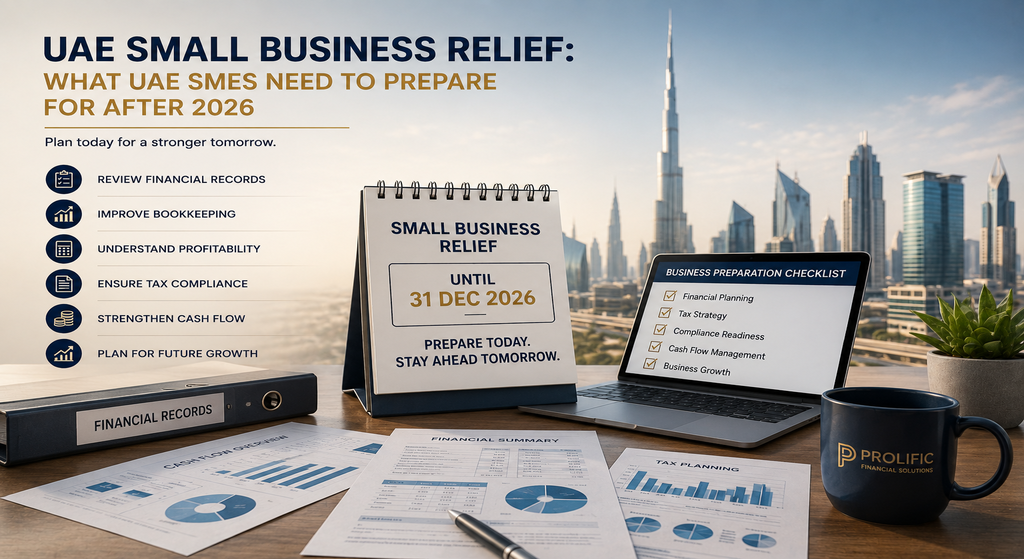
UAE Small Business Relief is currently available to eligible SMEs for Tax Periods ending on or before 31 December 2026. Learn how UAE businesses can prepare through better financial records, bookkeeping, cash-flow planning, profitability analysis and Corporate Tax compliance.

For small and medium-sized businesses in the UAE, tax compliance has become an increasingly important part of financial and business planning.
The introduction of Corporate Tax brought a new layer of responsibility for businesses across the country, while UAE Small Business Relief provided eligible smaller businesses with a way to reduce the immediate Corporate Tax and compliance burden.
However, Small Business Relief is not intended to be a permanent arrangement.
Under the current UAE Corporate Tax framework, Small Business Relief is available to eligible businesses for Tax Periods ending on or before 31 December 2026, subject to the applicable conditions. One of the key conditions is that the business’s Revenue must be AED 3 million or less in the relevant Tax Period and all previous Tax Periods.
For UAE business owners, the important question is no longer simply whether they can benefit from Small Business Relief.
The bigger question is:
What should an SME do now to be financially and operationally prepared when the relief is no longer available under the current rules? The answer involves more than tax calculations.
Businesses should look at their accounting systems, financial records, cash flow, profitability, compliance processes and overall business planning.
This guide explains what UAE SMEs should understand about the transition and how they can prepare without making unnecessary changes to their business structure.
What Is Small Business Relief in the UAE?
Small Business Relief is a provision within the UAE Corporate Tax system designed to support eligible smaller businesses.
The relief can reduce the Corporate Tax and compliance burden for qualifying businesses. Where the relevant conditions are satisfied and the business makes the required election, it is treated as having no Taxable Income for the applicable Tax Period.
The Federal Tax Authority explains that Small Business Relief is available to eligible Resident Persons, including natural persons and juridical persons, subject to specific conditions.
One of the main conditions is that the business must have Revenue of AED 3 million or less in both the relevant Tax Period and all previous Tax Periods. The election is made for each Tax Period.
It is also important to understand that Small Business Relief is not a general exemption from UAE Corporate Tax.
It is a specific relief available under defined conditions.
Certain businesses cannot elect for Small Business Relief. For example, a Qualifying Free Zone Person and a member of a multinational enterprise group meeting the applicable conditions are excluded from the relief.
This distinction is important for UAE businesses, particularly those operating from Free Zones.
For businesses that have been using Small Business Relief, the end of the current relief period means that financial planning should become more proactive.
Why 2026 Is an Important Year for UAE SMEs
The end of Small Business Relief does not mean that businesses need to panic.
Instead, it gives SMEs an opportunity to review how they manage their finances before the tax environment changes.
Many small businesses initially focused on understanding whether they were required to register for Corporate Tax, whether they could use Small Business Relief and how to complete their compliance obligations.
As businesses become more familiar with the UAE Corporate Tax environment, the focus is gradually moving toward long-term financial management.
This is where 2026 becomes significant.
Rather than waiting until the relief is no longer available, businesses can use the current period to:
- Review their financial records
- Improve bookkeeping processes
- Understand their profitability
- Organise supporting documents
- Review Corporate Tax compliance
- Monitor business expenses
- Improve cash-flow planning
- Prepare more realistic financial forecasts
- Understand how future tax obligations could affect the business
The objective is simple: Make the transition predictable instead of treating it as an unexpected cost.
What Happens After Small Business Relief?
One of the most common misunderstandings is that the end of Small Business Relief automatically means that every SME will face the same Corporate Tax burden. That is not necessarily the case.
The UAE Corporate Tax system is based on applicable rules for determining Taxable Income, and the tax position can differ depending on the business’s circumstances.
Businesses should therefore understand their own financial position rather than assuming that the end of a relief automatically translates into a specific tax bill.
This is why financial preparation is more useful than simply focusing on the end date of the relief.
A business that understands its revenue, expenses, accounting records, applicable deductions and profitability will be in a much stronger position to plan for future Corporate Tax obligations.
In other words, SMEs should move from:
“How can we benefit from the relief?”
“How can we manage our business efficiently under the normal tax framework?”
That change in mindset can make a significant difference to long-term business planning.
Revenue Is Not the Same as Profit
For many small business owners, revenue is one of the easiest financial numbers to understand.It represents the income generated through business activities. But revenue alone does not tell the complete story.
A company can have strong sales while also having significant operating costs. Another company may have lower sales but stronger profit margins.
This is why SMEs preparing for the post-relief environment should pay attention to profitability rather than looking only at turnover.
- Sales and service income
- Operating expenses
- Employee costs
- Office and administrative expenses
- Marketing expenditure
- Professional service costs
- Technology expenses
- Financing costs
- Other relevant business expenses
- Overall operating profit
Good bookkeeping makes it easier to understand these numbers. It also allows business owners to make better decisions about pricing, hiring, expansion and cash flow.
Better Bookkeeping Will Become More Important
One of the biggest practical lessons for SMEs is that proper bookkeeping should not be treated as an administrative task that is completed only when a tax deadline approaches.
Financial records are an important part of running a business. As Corporate Tax becomes part of normal business operations, companies need reliable records that explain how their financial position was reached.
This includes keeping appropriate invoices, contracts, receipts, bank records, expense documentation and other supporting information.
The Federal Tax Authority has established record-keeping and compliance requirements within the UAE tax system. Businesses should therefore maintain appropriate documentation and ensure that their accounting information can support their tax position.
For SMEs, this can be particularly important because business owners are often directly involved in sales, operations, employees, suppliers and financial decisions.
A structured accounting system reduces the risk of missing important information. It also provides management with better information for making financial decisions.
SMEs Should Review Their Financial Systems
The end of Small Business Relief is also a good reason for businesses to review the systems they currently use.
Some SMEs still manage their finances through spreadsheets, separate bank accounts, manual invoices and basic accounting records.
These methods may work during the early stages of a business.
However, as the company grows, financial information becomes more complicated.
Businesses may eventually have:
- Multiple revenue sources
- Different customer segments
- Several suppliers
- Employees and contractors
- Recurring expenses
- Multiple bank transactions
- Online payment platforms
- Digital subscriptions
- Business loans or financing
- Cross-border transactions
When financial information becomes more complex, manual processes can increase the possibility of errors.
SMEs should therefore consider whether their current accounting and bookkeeping process is strong enough for the next stage of business growth.
Cash Flow Should Be Part of the Preparation
Corporate Tax planning should not be considered separately from cash-flow planning. A profitable business can still experience cash-flow problems.
For example, a company may have completed several projects but still be waiting for customers to make payments. At the same time, the business may have salaries, rent, suppliers and other expenses that need to be paid.
Future tax obligations should therefore be considered when preparing cash-flow forecasts.
Businesses can benefit from maintaining a regular financial planning process that looks at:
Expected income → expected expenses → available cash → upcoming obligations → future financial commitments
This approach helps business owners understand whether they have sufficient liquidity to manage their obligations. Instead of treating tax as a surprise expense, SMEs can incorporate expected tax-related costs into their normal financial planning.
Review Your Corporate Tax Compliance
Another important step is reviewing the company’s existing Corporate Tax position.
Business owners should confirm that their Corporate Tax registration and compliance information is accurate and up to date.
The Federal Tax Authority provides Corporate Tax registration services for persons required to register under the applicable rules.
Businesses should also make sure that their records, company information and tax filings are properly maintained.
A compliance review can help identify issues before they become more difficult to resolve.
The review may include:
- Corporate Tax registration
- Tax return status
- Accounting records
- Supporting documents
- Business activity information
- Company structure
- Related-party transactions
- Financial reporting
- Record-keeping procedures
For businesses that are unsure about their specific tax position, professional tax advice can be useful.
Do Not Build Your Business Around a Temporary Relief
One of the broader lessons from Small Business Relief is that businesses should be careful about building long-term strategies around temporary government measures. Reliefs and incentives can be valuable.
They can help businesses manage costs, improve cash flow and adapt to new regulations. But businesses should still build a model that can operate sustainably without depending entirely on a temporary benefit.
This means looking at the fundamentals of the company.
Is the pricing appropriate?
Are expenses under control?
Are customers paying on time?
Are profit margins healthy?
Is the company maintaining accurate financial records?
Is the business prepared for future compliance costs?
These questions are more important for long-term sustainability than simply focusing on whether a particular relief is available.
What UAE SMEs Should Review Before the Relief Ends
There is no single preparation strategy that will work for every UAE business. However, most SMEs can benefit from reviewing several core areas.
1. Financial Records
Make sure income and expenses are properly recorded.
Businesses should avoid mixing personal and business transactions wherever possible and should maintain clear supporting documentation.
Clear records make financial analysis easier and can also support tax compliance.
2. Business Expenses
Review recurring expenses regularly.
Businesses sometimes continue paying for subscriptions, services or operational costs that no longer provide sufficient value.
A financial review can identify unnecessary costs and improve overall efficiency.
3. Pricing Strategy
Businesses should understand whether their current pricing reflects their actual cost of delivering products or services.
If costs increase over time but pricing remains unchanged, profit margins can gradually decline.
Preparing for future tax obligations can therefore also be an opportunity to review pricing.
4. Profitability
Revenue growth is important, but profitable growth is more sustainable.
SMEs should understand which products, services or customer segments generate the strongest margins.
This information can help management make better decisions about where to invest resources.
5. Cash Flow
Create regular cash-flow forecasts instead of looking only at historical financial statements.
This can help businesses prepare for upcoming expenses and financial commitments.
6. Documentation
Organise invoices, contracts, receipts, bank statements and other relevant financial records.
A well-organised documentation system can save considerable time when financial information is required.
7. Professional Advice
Some tax situations can become complicated, particularly when businesses have multiple activities, related entities, international transactions or complex ownership structures.
Professional advice can help businesses understand how the rules apply to their individual circumstances.
Small Businesses Should Also Think About Growth
Preparing for the end of Small Business Relief does not mean that SMEs should stop growing. Growth should continue to be part of the business strategy. However, expansion should be supported by proper financial planning.
For example, a business considering:
- Opening a new branch
- Hiring additional employees
- Launching a new service
- Expanding into another emirate
- Entering international markets
- Increasing marketing expenditure
- Purchasing new equipment
- Taking business financing
should consider the financial impact of the decision.
The business should understand not only the potential revenue but also the associated costs and future obligations. This creates a more realistic picture of growth.
How Better Financial Planning Can Help SMEs
Financial planning is not only about tax. It can improve many areas of business management.
A business with accurate financial information can make better decisions about:
Hiring
Management can determine whether the company can comfortably support additional employees.
Marketing
Businesses can identify which marketing activities are producing useful results instead of spending without measurement.
Financing
Clear financial records can make discussions with banks and financial institutions more structured.
Expansion
Business owners can evaluate whether expansion is financially sustainable.
Pricing
Companies can understand whether their prices are sufficient to cover operating costs and maintain healthy margins.
Cash Flow
Management can identify potential cash shortages before they become serious problems. This is why the end of Small Business Relief should be viewed as part of a wider financial planning conversation.
UAE SMEs Should Prepare for a More Structured Business Environment
The UAE continues to develop its regulatory and business environment.
For SMEs, this means that maintaining accurate records and following compliance requirements is becoming an increasingly normal part of operating a professional business.
The Federal Tax Authority continues to provide Corporate Tax guidance, educational material, public clarifications and other resources to help taxpayers understand their responsibilities. The FTA also continues to update its Corporate Tax resources and guidance.
This shows that Corporate Tax compliance is not something businesses should consider only at filing time. It should become part of the company’s regular financial management process.
Common Mistakes SMEs Should Avoid
As businesses prepare for the end of Small Business Relief, several common mistakes should be avoided.
Waiting Until the Last Minute
Tax and financial preparation becomes much easier when businesses review their position throughout the year.
Looking Only at Revenue
Revenue provides useful information, but it does not explain the full financial position of a business. Profitability, expenses and Taxable Income also need to be understood.
Keeping Poor Records
Missing invoices, unclear transactions and incomplete documentation can make financial reporting more difficult.
Treating Tax as an Accounting Issue Only
Tax can influence pricing, cash flow, expansion and business strategy. It should therefore be considered as part of broader financial planning.
Assuming Every SME Has the Same Tax Position
Different businesses can have different structures, activities and circumstances. A company should not assume that another business’s tax treatment automatically applies to it.
Ignoring Regulatory Updates
The UAE tax framework continues to develop. Businesses should monitor official updates rather than relying solely on old information or social media discussions.
A Practical Preparation Plan for UAE Business Owners
SMEs do not need to transform their entire business overnight. A gradual approach can be more practical.
Step One: Understand Your Current Position
Review your accounting records and understand where the business currently stands.
Step Two: Organise Your Documents
Make sure financial and business records are properly stored and accessible.
Step Three: Review Your Costs
Identify recurring expenses and determine whether they are still necessary.
Step Four: Understand Your Profitability
Look beyond sales and understand how much the business actually earns after operating costs.
Step Five: Review Corporate Tax Compliance
Check registration, filings and relevant documentation.
Step Six: Forecast Future Obligations
Prepare a realistic financial forecast for the period after Small Business Relief.
Step Seven: Update Your Business Budget
Include expected compliance and tax-related costs in future budgets.
Step Eight: Seek Professional Guidance Where Necessary
If your business has a complicated structure or tax position, speak with an appropriately qualified professional.
What Does This Mean for New UAE Businesses?
The discussion around Small Business Relief is also relevant to entrepreneurs planning to establish a business in the UAE.
New businesses should understand from the beginning that financial compliance is part of operating a legitimate and sustainable company.
Instead of creating accounting systems only when the business becomes larger, entrepreneurs can establish good financial habits from the start.
This can include:
- Maintaining separate business finances
- Keeping proper invoices
- Recording expenses
- Monitoring cash flow
- Maintaining contracts
- Tracking customer payments
- Reviewing profitability
- Understanding applicable tax obligations
Good financial administration may not seem important during the early stages of a business, but it becomes increasingly valuable as the company grows.
The Opportunity Behind the Change
The end of a relief mechanism can initially sound like a negative development. However, there is another way to look at it.
For many SMEs, this can be an opportunity to move from informal financial management toward a more structured business model.
A company that has accurate accounts, reliable financial information, organised documentation and a clear understanding of its costs is generally better prepared for growth.
It is also better positioned to speak with banks, investors, partners and professional advisers. In that sense, preparing for the end of Small Business Relief is not simply about preparing for tax.
It is about preparing the business for its next stage.
Final Thoughts: Preparing Your UAE SME for What Comes Next
The UAE Small Business Relief framework has provided eligible businesses with valuable support during the early stage of the Corporate Tax environment.
Under the current rules, the relief is available for eligible Tax Periods ending on or before 31 December 2026, provided the applicable conditions are satisfied. This includes the AED 3 million Revenue threshold for the relevant and previous Tax Periods.
For SMEs, the most sensible response is not to wait until the relief ends.
Instead, businesses can use this period to improve their financial systems, understand their profitability, organise documentation, review Corporate Tax compliance and build more realistic financial forecasts.
The transition can also encourage business owners to look beyond short-term tax considerations and focus on the fundamentals that support sustainable growth.
A well-prepared business is not simply one that knows its tax obligations. It is a business that understands its numbers, controls its costs, manages its cash flow and plans ahead.
For UAE SMEs, that preparation can make the transition after Small Business Relief much smoother and provide a stronger foundation for the next phase of business growth.
Frequently Asked Questions About UAE Small Business Relief
What is UAE Small Business Relief?
UAE Small Business Relief is a Corporate Tax relief designed to reduce the Corporate Tax and compliance burden for eligible smaller businesses that meet the applicable conditions.
Where a valid election is made, the eligible business is treated as having no Taxable Income for the relevant Tax Period.
Is Small Business Relief permanent?
No.
Under the current framework, Small Business Relief is available for eligible Tax Periods ending on or before 31 December 2026.
Businesses should continue to monitor official UAE tax updates for any future changes.
What is the Revenue threshold for Small Business Relief?
Under the current rules, a Resident Person may elect for Small Business Relief where Revenue is AED 3 million or less in the relevant Tax Period and all previous Tax Periods, subject to the other applicable conditions.
Does the end of Small Business Relief mean every SME will pay the same amount of Corporate Tax?
No.
Corporate Tax treatment depends on the applicable rules and the individual circumstances of the business.
SMEs should understand their Taxable Income and overall financial position rather than assuming that the end of a relief results in a fixed tax cost.
Can every UAE business claim Small Business Relief?
No.
The relief is subject to specific eligibility conditions.
For example, a Qualifying Free Zone Person cannot elect for Small Business Relief. Certain members of multinational enterprise groups are also excluded where the applicable conditions are met.
Businesses operating in a Free Zone should therefore review their specific Corporate Tax status before assuming that Small Business Relief is available.
What should SMEs do before the relief ends?
Businesses should review their accounting systems, financial records, profitability, expenses, cash flow and Corporate Tax compliance.
Preparing financial forecasts can also help businesses plan for future obligations.
Should UAE SMEs change their business structure because the relief is ending?
Not necessarily.
A business structure should be considered based on commercial, legal, financial and tax factors rather than simply because a particular relief is ending.
Businesses considering restructuring should obtain appropriate professional advice.
Why is bookkeeping important for Corporate Tax?
Accurate bookkeeping helps businesses understand their financial position and maintain supporting records for their tax and financial reporting requirements.
It also helps management make better business decisions.
Do Free Zone companies qualify for Small Business Relief?
Not all Free Zone businesses are treated in the same way.
A Qualifying Free Zone Person is not eligible to elect for Small Business Relief. Other Free Zone businesses should review their specific Corporate Tax status and applicable conditions before determining whether the relief is available.
Where can businesses find official UAE Corporate Tax information?
The Federal Tax Authority publishes Corporate Tax guidance, legislation, public clarifications, educational resources and other official information for taxpayers.
Businesses should refer to official UAE authority sources when checking current requirements.
Practical Reminder for UAE Business Owners
Small Business Relief is only one part of the broader UAE Corporate Tax framework. Business owners should not make tax, restructuring or financial decisions solely on the basis of a general article.
The appropriate treatment can depend on the company’s legal structure, activities, Revenue, Tax Period, Free Zone status, ownership structure and other circumstances.
Where there is uncertainty, businesses should obtain advice from an appropriately qualified tax professional.
Disclaimer
This article is provided for general educational and informational purposes only and does not constitute tax, legal, accounting or financial advice.
UAE Corporate Tax rules, regulations and related guidance may be updated from time to time. The application of tax rules can also vary depending on the individual circumstances, structure, activities and financial position of a business.
Businesses should review the latest information issued by the relevant UAE authorities and seek qualified professional advice where appropriate.
Source: Federal Tax Authority and UAE Ministry of Finance official Corporate Tax resources.
About Prolific Enterprises FZE LLC
Prolific Enterprises FZE LLC supports UAE businesses with practical business and financial solutions, including business finance, corporate banking assistance, working capital facilities, machinery and equipment finance, mortgage finance and related business support services.
For businesses preparing for their next stage of growth, having a clear understanding of financial records, cash flow and funding requirements can make a significant difference.
Finance, Growth, Unified.
Visit Prolific Enterprises FZE LLC https://prolificbizgroup.com/