 UAE Trusted

UAE Banking for New Companies:Why Opening a Corporate Bank Account Can Be Challenging
Opening a corporate bank account in the UAE can be more detailed for newly established companies. Learn about the key challenges, documentation, KYC requirements, ownership structure, source of funds, and practical steps new businesses should consider before applying.

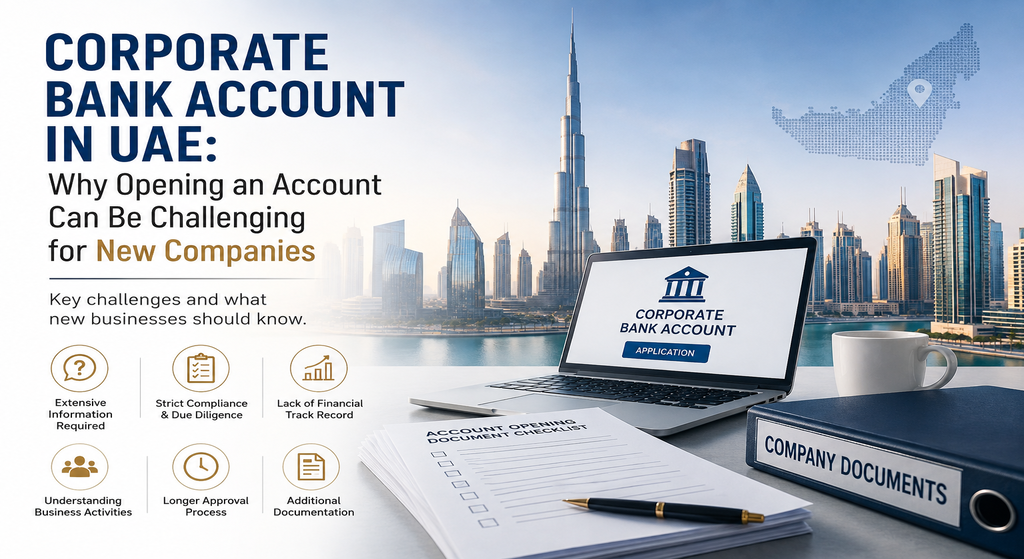
Starting a new company in the UAE involves more than obtaining a trade license and setting up an office or business address. Once the company is established, one of the most important steps is opening a corporate bank account in the UAE.
A corporate bank account provides a dedicated financial channel for the company’s business activities. It allows a company to receive payments from customers, pay suppliers, manage operating expenses, process business-related transfers and maintain organized financial records.
However, many entrepreneurs discover that opening a corporate bank account in the UAE can require more preparation than expected, particularly when the company is newly established.
An established business may already have financial statements, banking history, regular transactions, established customers and suppliers, and a clear operating track record. A newly incorporated company may not have these records yet.
This means that the bank may need to understand the business through other information, including its business activity, ownership structure, management background, source of funds, expected transactions, customers, suppliers and purpose of the account.
This does not mean that opening a UAE corporate bank account for a new company is impossible. It means that the company should be properly prepared before starting the application process.
This guide explains the main factors that can make corporate bank account opening more detailed for new UAE companies and how business owners can prepare for the process.
Why Do New Companies Need a Corporate Bank Account?
A corporate bank account creates a dedicated financial channel for a company’s business activities.
Once a company begins operating, it may need to:
- Receive payments from customers
- Make payments to suppliers
- Pay business expenses
- Process local and international transfers
- Pay employees and service providers
- Manage working capital
- Maintain organised accounting records
Keeping these transactions through a dedicated business bank account in the UAE can help separate business finances from the personal finances of the owners.
This separation can make it easier for business owners to monitor revenue, expenses, cash flow and the overall financial position of the company.
For a growing business, the corporate bank account can become an important part of its financial infrastructure.
However, before establishing a banking relationship, the financial institution needs to understand the company, its activities and the expected use of the account.
This is one of the reasons why newly established businesses may receive additional questions during the account-opening process.
Why Is Corporate Account Opening in the UAE Challenging for New Companies?
One of the main challenges for a newly established company is the lack of an established financial history.
A new company may not yet have:
- A long transaction history
- Established customer relationships
- Extensive financial statements
- Previous corporate banking records
- Regular business cash flow
- A significant operating history
An established company can often demonstrate its business activities through historical transactions and financial records. A new company has to provide other information that helps the bank understand how the business is expected to operate.
This can include information about:
- Business activities
- Ownership structure
- Management
- Source of funds
- Expected customers
- Expected suppliers
- Target markets
- Expected account activity
- Purpose of the banking relationship
Financial institutions also have customer identification and financial crime compliance obligations. As part of customer due diligence, they may need to understand who owns and controls the company and the nature and purpose of the proposed banking relationship.
Therefore, opening a corporate bank account in the UAE involves more than submitting a company licence.
1. Banks Need to Understand What the Company Does
One of the first things a financial institution needs to understand is the company’s actual business activity.
A company may have a valid trade licence, but the bank may still need to understand how the business operates in practice.
Depending on the nature of the business, questions may include:
- What products or services does the company provide?
- Who are the target customers?
- Where are the customers located?
- How does the company generate revenue?
- Does the company operate locally or internationally?
- Who are the expected suppliers?
- What types of payments will the company receive?
- What types of payments will the company make?
A clear explanation of the business model can help the financial institution understand the proposed account activity.
For example, a technology company should be able to explain the technology services it provides and its intended customer base.
Similarly, a trading company should be able to explain the products it trades, its sourcing arrangements, target markets, suppliers and customers.
The business activity described during the banking application should be consistent with the company’s actual plans and official documentation.
2. New Businesses Have Limited Financial History
An established business can demonstrate its operations through previous financial records, customer relationships and banking activity.
A newly established company may not have the same evidence.
This is one reason UAE banking for new companies can involve additional questions.
Instead of relying primarily on historical transactions, the financial institution may need to understand the company’s planned operations.
Instead of relying primarily on historical transactions, the financial institution may need to understand the company’s planned operations.
The business owner may therefore need to explain:
- The purpose of the company
- The founders’ relevant experience
- The planned business model
- Expected sources of income
- Target markets
- Expected customers
- Expected suppliers
- Anticipated account activity
A new business does not necessarily need a long operating history to explain its proposed banking relationship.
What is important is that the information provided is clear, consistent and supported by appropriate documentation where required.
3. Know Your Customer Requirements Are Important
Know Your Customer, commonly known as KYC, is an important part of the corporate banking process.
Financial institutions need to establish who their customers are and understand the nature of the relationship they are entering into.
For a company, this involves more than identifying the legal entity.
The bank may also need to identify relevant individuals connected with the company, including:
- Shareholders
- Beneficial owners
- Directors or managers
- Authorised representatives
- Signatories
This is why corporate banking in the UAE can involve documentation for both the company and the individuals behind it.
The objective of KYC and customer due diligence is to help financial institutions understand their customers and assess financial crime risks.
For entrepreneurs, the practical lesson is straightforward: company information and personal identification documents should be accurate, current and consistent.
4. Ownership Structure Needs to Be Clear
The ownership structure of a company is another important part of the corporate account-opening process.
Some UAE companies have straightforward ownership structures where individuals directly own the company.
Others may involve:
- Multiple shareholders
- Corporate shareholders
- Holding companies
- Companies incorporated in different jurisdictions
- More complex ownership arrangements
The financial institution may need to understand who ultimately owns or controls the company.
This is commonly connected with identifying the Ultimate Beneficial Owner (UBO).
Businesses should maintain clear records showing, where applicable:
- Shareholders
- Ownership percentages
- Directors or managers
- Authorised signatories
- Ultimate beneficial owners
- Relevant corporate entities within the ownership structure
For companies with more complex structures, additional documentation or clarification may be requested.
Providing accurate ownership information can help reduce unnecessary confusion during the banking process.
5. The Source of Funds May Need to Be Explained
New companies often require initial funding to start their operations.
The financial institution may need to understand where the company’s funds originate and how the business expects to generate income.
This forms part of the broader customer due diligence process.
For example, the company may need to explain whether its initial business funds come from:
- The owner’s personal resources
- Existing business activities
- Investment
- Shareholder funding
- Another legitimate source
The exact information and supporting documents required can vary depending on the company, its ownership structure and the financial institution’s procedures.
The important point is that business owners should be prepared to explain the legitimate source of business funds when requested.
An unclear explanation may result in additional questions or requests for supporting information.
6. Business Activities and Company Documents Should Match
Consistency is extremely important when opening a corporate bank account in the UAE.The information provided during the banking application should be consistent with the company’s official documents and actual business plans.
For example, if a company’s trade licence describes one type of business activity but the banking application describes a substantially different activity, the financial institution may request clarification.
Before applying, businesses should review their information and ensure that:
- The company name is consistent across documents
- Business activities are accurately described
- Shareholder information is correct
- Ownership details are current
- Authorised signatories are correctly identified
- The company’s business purpose is clearly explained
- The proposed account activity is consistent with the business model
Small inconsistencies can sometimes result in unnecessary questions. A well-organised application gives the bank a clearer understanding of the business.
7. Expected Transactions Can Be Part of the Assessment
A new company does not have an established transaction history.
The bank may therefore need to understand what type of activity the company expects to conduct through its corporate account.
This may include:
- Customer payments
- Supplier payments
- Local transfers
- International transfers
- Business expenses
- Employee-related payments
- Service-provider payments
- Other legitimate business transactions
The expected transaction profile should make sense for the company’s business model. For example, a consulting company may have a different transaction pattern from an import and export business.
A company serving international customers may also have different banking requirements from a business serving customers primarily within the UAE.
Businesses should therefore be prepared to explain the expected nature and volume of their banking activity where requested.
8. International Transactions May Require Additional Information
Many UAE businesses operate across borders.
A company may have:
- International customers
- Overseas suppliers
- Foreign shareholders
- International service providers
- Business relationships outside the UAE
International activity is a normal part of many legitimate business models. However, it may require the company to provide additional information so that the financial institution can understand the proposed transactions.
The bank may need to understand:
- Which countries are involved
- Why international payments are required
- What goods or services are involved
- Who the relevant counterparties are
- Where funds are expected to originate
- Where payments are expected to be sent
Businesses planning international operations should therefore have a clear understanding of their expected cross-border activities.
9. Company Documentation Needs to Be Organised
One of the most practical steps for a new business is preparing its documents before beginning the UAE corporate bank account opening process.
Depending on the company structure, business activity and account type, documents may include:
- Valid trade or commercial licence
- Incorporation documents
- Memorandum or Articles of Association
- Shareholder information
- Passport and EID copy
- Identification documents where applicable
- Proof of business address
- Ownership information
- Board or shareholder resolutions where applicable
- Company profile
- Business plan or supporting information
- Financial information, where available
The exact requirements vary between financial institutions and can also depend on the company’s structure and proposed banking relationship.
For this reason, businesses should confirm the current requirements with the relevant financial institution before submitting an application.
10. A Company Profile Can Help Explain a New Business
A company profile can be particularly useful for a newly established business.
A new company may not have a long financial history, but a well-prepared company profile can provide useful context about the business and its planned operations.
A company profile can explain:
Company Overview
What the business does and why it was established.
Products or Services
What the company provides to customers.
Target Market
Who the intended customers are and where they are located.
Business Model
How the company expects to generate revenue.
Management Background
Relevant professional or business experience of the founders and management team.
Expected Operations
How the business plans to operate, including its expected customers, suppliers and banking activities.
The purpose of a company profile is not to create a complicated presentation. Its purpose is to make the business easier to understand.
11. Business Experience Can Provide Additional Context
A company may be newly incorporated while its founders or management team have previous experience in the same or a related industry.
This experience can provide useful background when explaining the proposed business.
For example, an entrepreneur establishing a consulting company may already have experience in the relevant sector.
Similarly, an entrepreneur starting a trading business may have previous knowledge of the products, markets, suppliers or customers involved.
Relevant experience does not guarantee account approval.
However, explaining the professional and business background behind a new company can provide additional context about the company’s proposed activities and operating model.
12. Business Structure Can Affect the Banking Process
The UAE has different business establishment options, and companies can have different legal and ownership structures.
A business may be established in:
- Mainland
- A free zone
- Another permitted UAE business structure
The banking process can vary depending on factors such as:
- Company structure
- Ownership
- Business activity
- Geographic exposure
- Expected transactions
- Account requirements
- Financial institution policies
There is therefore no single UAE business bank account requirement that applies identically to every company.
Entrepreneurs should avoid assuming that the requirements for one company or financial institution will automatically apply to another.
The appropriate approach is to understand the company’s own structure and then review the requirements of the financial institution being considered.
Risk Assessment Is Part of Corporate Banking
Financial institutions use risk-based approaches when reviewing customers.
This means that different companies may receive different levels of review depending on their individual circumstances.
Factors that may be relevant to the assessment can include:
- Nature of the business
- Ownership structure
- Geographic exposure
- Expected transaction activity
- Customer profile
- Source of funds
- Complexity of operations
- Other relevant risk factors
A company receiving additional questions should not automatically assume that something is wrong. Additional verification may simply mean that the financial institution needs more information to complete its assessment. The best approach is to provide accurate, relevant and consistent information.
14. Why Corporate Account Opening May Take More Preparation
Entrepreneurs sometimes expect corporate account opening to be similar to opening a personal bank account.
Corporate banking is different because the financial institution needs to understand both the company and the people behind it.
The assessment may involve information about:
- The company
- The owners
- The beneficial owners
- The authorised representatives
- The business activity
- The source of funds
- The expected transaction profile
- The purpose of the account
This creates a broader verification process. If information is incomplete, unclear or inconsistent, the financial institution may request additional clarification. Preparation before applying can therefore make the process more organised and help the company respond to questions more efficiently.
Common Issues New Companies Should Watch For
Several avoidable issues can make the corporate account opening process in the UAE more complicated.
Incomplete Documentation
Missing documents may result in additional requests.
Outdated Information
Expired or outdated company documents may need to be updated.
Unclear Business Activity
A vague explanation of what the company does can lead to additional questions.
Unclear Ownership
If shareholders or beneficial owners cannot be clearly identified, additional documentation may be required.
Inconsistent Information
Differences between company documents and information provided during the application can create confusion.
Unclear Source of Funds
Businesses should be prepared to explain the legitimate source of funds when requested.
Unclear Transaction Expectations
The company should have a reasonable understanding of how it expects to use the corporate account.
Lack of Preparation
Submitting an application without reviewing the company’s documents and business information first can create avoidable delays.
How New Companies Can Prepare for UAE Corporate Banking
Preparation does not guarantee account approval, but it can make the application process more organised.
1. Keep Company Documents Together
Maintain an organised digital and physical record of important incorporation, licensing and ownership documents.
2. Prepare a Simple Company Profile
Be able to explain what the company does, who its customers are, who its suppliers are and how the business operates.
3. Understand Your Ownership Structure
Know the shareholders, authorised representatives and ultimate beneficial owners of the company.
4. Prepare Source-of-Funds Information
Understand how the company was initially funded and be ready to provide appropriate supporting information if required.
5. Understand Your Expected Banking Activity
Think about the payments the company expects to receive and make, including local and international transactions where applicable.
6. Review All Information Before Applying
Check company names, ownership information, business activities and other details for consistency.
7. Check Current Banking Requirements
Banking requirements and onboarding procedures can change. Always confirm the latest requirements with the relevant financial institution.
How to Choose a Corporate Bank Account for a New Company
Opening a corporate bank account is only the beginning of a company’s banking relationship. Entrepreneurs should also consider what banking services the business may require as it grows.
Depending on the nature of the company, these may include:
- Business online banking
- Local payments
- International payments
- Multi-currency services
- Business payment solutions
- Payroll-related banking services
- Trade-related services
- Business financing
- Working capital facilities
- Cash-management solutions
The right corporate bank account in the UAE should be suitable for the company’s actual operating requirements. A business should therefore consider not only the immediate account-opening requirement but also its expected banking needs as the company develops.
Corporate Banking and Financial Organisation
Opening a corporate account can also encourage better financial discipline.
When business transactions are separated from personal transactions, owners can more easily monitor the financial performance of the company.
This can support:
- Accounting
- Expense tracking
- Cash-flow monitoring
- Financial reporting
- Business planning
- Tax-related record keeping
- Understanding business profitability
Good financial organisation is valuable regardless of the company’s size. For a new business, developing these practices from the beginning can make future financial management more structured.
How Prolific Can Help With Corporate Bank Account Opening in the UAE
Opening a corporate bank account can involve more than simply submitting a trade licence. At Prolific Enterprises FZE LLC, we assist UAE businesses and entrepreneurs with corporate banking requirements and help them prepare the information needed to present their business clearly to financial institutions.
Our support can include:
- Understanding the company’s banking requirements
- Reviewing available banking options based on the company’s profile
- Preparing or reviewing company profiles and business model information
- Organising KYC and corporate documentation
- Supporting responses to bank compliance queries
- Helping clarify business activities and expected transactions
- Coordinating the account-opening process
- Providing guidance for UAE companies, including newly established businesses
Every company is different, and banking requirements can vary depending on the financial institution, business activity, ownership structure and expected account activity.
Our approach is therefore based on understanding the business first and then helping prepare the application accordingly. Account approval is always subject to the relevant financial institution’s internal policies, eligibility criteria and compliance assessment.
What Should a New UAE Company Do Before Applying?
Before starting the corporate account-opening process, business owners should ask themselves:
Can I clearly explain what my company does?
The business activity should be clear and consistent with the company’s licence and proposed operations.
Can I explain who owns and controls the company?
The shareholder and beneficial ownership structure should be clear.
Can I explain where the business funds come from?
The company should be prepared to explain its legitimate source of funds when required.
Can I explain who the expected customers are?
The company should have a reasonable understanding of its target customers and markets.
Can I explain what types of transactions the account will handle?
The expected banking activity should be consistent with the business model.
Are my company documents complete and current?
Important corporate and identification documents should be organised and valid.
Is the information across my documents consistent?
Names, ownership details, business activities and other important information should match.
If the answer to these questions is yes, the company is generally better prepared to approach the banking process.
Preparation does not guarantee approval from a particular financial institution.
It simply helps reduce avoidable uncertainty and allows the business to present its information clearly.
UAE Banking for Startups and Newly Established Businesses
Startups and newly established businesses can face some of the same challenges as other new companies.
A startup may have a strong business idea but limited operating history.
For this reason, it can be particularly important to explain:
- The business model
- The founders’ background
- The target market
- The products or services
- Expected customers
- Expected suppliers
- Planned operations
- Expected banking activity
A startup seeking corporate banking in the UAE should focus on presenting a realistic and transparent picture of the business rather than relying only on future growth expectations.
A clear business model, organised documentation and transparent ownership structure can help provide context for the proposed banking relationship. The same principle applies to entrepreneurs establishing their first company in the UAE.
Why Preparation Matters More Than Simply Applying
One common mistake entrepreneurs make is treating corporate account opening as a formality that comes after company formation.
In reality, banking should be considered part of the broader business setup process. A company may have a valid trade licence and legal structure, but it still needs appropriate financial infrastructure to operate effectively.
Preparing documents, understanding ownership, defining business activities and considering expected transactions before applying can make the process more structured. It can also help business owners better understand their own financial requirements.
The objective should not be to find shortcuts around banking or compliance requirements. The objective should be to provide a clear, accurate and transparent picture of the company.
Final Thoughts
Opening a corporate bank account in the UAE is an important step for a newly established business. However, the process can be more detailed than many entrepreneurs initially expect.
Financial institutions need to understand more than the company’s name and trade licence. They may need to establish who owns and controls the business, understand its activities, assess the purpose of the banking relationship and obtain sufficient information about expected financial activity.
For new companies, the absence of an established operating history can make preparation particularly important.
A business that can clearly explain its activities, ownership structure, source of funds, expected transactions and business purpose is better positioned to navigate the account-opening process.The goal should not be to find shortcuts around the banking process.
The goal should be to present a clear, accurate and transparent picture of the company.For entrepreneurs establishing a business in the UAE, corporate banking should therefore be considered an important part of business planning rather than simply another administrative task.
A well-prepared company can make its banking requirements easier to understand and create a stronger foundation for managing its finances as the business grows.
Frequently Asked Questions About Corporate Bank Accounts in the UAE
Why is opening a corporate bank account difficult for a new company in the UAE?
New companies often have limited financial and banking history. Financial institutions may therefore request additional information about the company’s business activity, ownership, source of funds, expected transactions and purpose of the account.
What is needed to open a corporate bank account in the UAE?
Requirements vary depending on the financial institution, company structure, business activity and account type. Businesses may commonly need company formation and licensing documents, ownership information, identification documents and other supporting information.
Can a newly established company open a UAE corporate bank account?
A newly established company may apply for a corporate bank account. However, eligibility and requirements depend on the financial institution and the company’s individual circumstances.
Why do banks ask about the UBO?
The Ultimate Beneficial Owner, or UBO, refers to the individual or individuals who ultimately own or control a company. Identifying beneficial ownership is an important part of customer due diligence.
Why does the bank need to know what my company does?
Understanding the company’s business activity helps the financial institution understand the purpose and expected nature of the banking relationship.
Why are source-of-funds questions asked?
Financial institutions may need to understand where business funds originate as part of customer due diligence and financial crime compliance procedures.
Can a free zone company open a corporate bank account in the UAE?
A free zone company may apply for a corporate bank account, but the ability to open an account depends on the financial institution’s criteria, the company’s structure, business activity and other relevant factors.
Can a company with international customers open a UAE business account?
International business activity does not automatically prevent a company from applying for a UAE corporate account. However, the financial institution may request information about international customers, suppliers, countries involved and expected transactions.
How can a new company prepare for corporate account opening?
The company should organise its incorporation and licensing documents, understand its ownership structure, prepare a clear company profile, explain its business activity and source of funds, and understand its expected banking transactions.
Is corporate banking the same for every UAE company?
No. Requirements can differ based on the company’s legal structure, ownership, business activity, expected transactions and the policies of the financial institution.
Need Help With Corporate Bank Account Opening in the UAE?
If you are establishing a new company in the UAE and need support understanding the corporate banking process, Prolific Enterprises FZE LLC can assist with corporate banking preparation and application coordination.
We can help you understand the documentation, business information and compliance requirements that may be relevant to your company’s profile.
We can help you understand the documentation, business information and compliance requirements that may be relevant to your company’s profile. Contact Prolific to discuss your corporate banking requirement.
Disclaimer
This article is intended for general educational and informational purposes only. Corporate bank account requirements, eligibility criteria, documentation and onboarding procedures can vary between financial institutions and may change over time.
Information provided in this article does not constitute a guarantee of account opening or approval by any financial institution.
Businesses should confirm current requirements directly with the relevant financial institution and seek appropriate professional advice where necessary.