 UAE Trusted

How to Build a Monthly Social Media Content Plan for a UAE Service Business
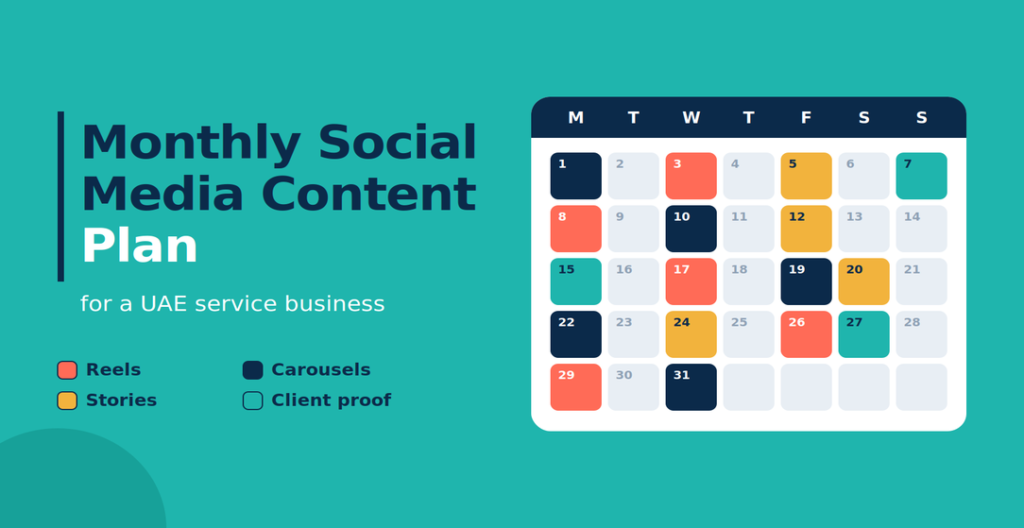
Plan a full month of social content with a simple mix of Reels, Carousels, Stories and client proof, built for UAE service businesses.

Running social media for a service business can become difficult when there is no physical product to photograph or launch every week.
A UAE digital marketing agency, business consultant, financial services company, corporate services provider, law firm, real estate consultancy or professional advisory firm may have several services to promote, but that does not mean every social media post should be a service advertisement.
The bigger challenge is deciding what to say, who to say it to and why the audience should care.
A monthly social media content plan helps solve that problem.
Instead of opening Instagram or LinkedIn every morning and asking, “What should we post today?”, a structured content plan gives the business a clear direction for the entire month.
More importantly, a good content plan should connect social media activity with the actual business objectives of the company.
What Is a Social Media Content Plan?
A social media content plan is a structured schedule that defines what a business will publish during a particular period.
It normally includes:
- Content topics
- Content categories
- Platforms
- Formats
- Publishing dates
- Captions or key messages
- Calls to action
- Responsible team members
- Campaigns or important dates
- Performance metrics
For a service business, however, planning should go beyond creating a calendar of dates.
The real purpose is to make sure that the content collectively answers the questions a potential client may have before deciding to contact the company.
Why UAE Service Businesses Need a Planned Content Strategy
Without a plan, service-business social media often falls into one of two patterns.
The first is excessive promotion:
“Our services.”
“Contact us today.”
“We help businesses grow.”
The second is random content:
“Monday motivation.”
“Happy Friday.”
“Did you know?”
Neither approach necessarily helps a potential client understand the business.
A monthly content plan gives the company an opportunity to balance:
Education + Expertise + Trust + Brand Awareness + Services + Conversion
This is especially important for B2B and professional services, where customers may need time to understand a service before making a decision.
Step 1: Start With the Business Goal
Do not begin by choosing Instagram post designs.
Begin by asking:
What does the business actually want social media to support this month?
Possible objectives include:
- Generating enquiries
- Increasing awareness
- Promoting a specific service
- Building credibility
- Educating the target audience
- Supporting lead-generation campaigns
- Increasing website visits
- Introducing a new service
- Strengthening the company’s professional presence
A company promoting SEO services, for example, may decide that its primary monthly objective is to generate more enquiries from UAE SMEs. That objective should influence the topics selected throughout the month.
If the goal is lead generation, the content should not consist entirely of general awareness posts. There should also be content that explains the service, demonstrates expertise and gives interested prospects a clear next step.
Step 2: Identify Who You Are Creating Content For
A service business cannot create effective content without understanding its audience.
“UAE businesses” is usually too broad.
Think about the actual people you want to reach.
For example:
- SME owners
- Founders
- Marketing managers
- Finance managers
- HR professionals
- Operations managers
- Startup founders
- E-commerce business owners
- Professional service firms
Then consider what those people are likely to worry about.
A business owner may be thinking:
“Why aren’t we getting enough leads?”
A marketing manager may be thinking:
“How can we improve our website’s organic visibility?”
A finance manager may be thinking:
“What options can help us manage working capital?”
These questions can become content topics.
Step 3: List Your Core Services
Before creating the calendar, make a simple list of the services the company wants to promote.
For example, a digital marketing company might offer:
- SEO
- Social media management
- Google Ads
- Meta Ads
- LinkedIn marketing
- Website development
- Lead generation
- Content marketing
A financial services company might offer:
- Corporate bank account assistance
- Business finance assistance
- Invoice discounting
- Trade finance
- Merchant financing
- Mortgage-related services
Do not assume that simply posting the service name will educate the audience.
Break every service into smaller content opportunities.
For example:
SEO
Instead of one post called:
“Our SEO Services”
create several useful topics:
- What is SEO?
- Why do service businesses need SEO?
- What is technical SEO?
- Why search intent matters
- Common SEO mistakes
- What happens during an SEO audit?
- SEO vs Google Ads
- Questions to ask before hiring an SEO agency
One service can therefore provide several weeks of content.
Step 4: Create Content Pillars
Content pillars are the main categories that organise your social media topics.
For a UAE service business, useful pillars may include:
1. Educational Content
Explain concepts your audience needs to understand.
Example:
“What Is Technical SEO and Why Does It Matter?”
2. Problem-Solution Content
Discuss a problem and explain possible ways to approach it.
Example:
“Your Website Gets Traffic but Few Enquiries. What Could Be Wrong?”
3. Service Education
Explain what your service actually involves.
Example:
“What Is Included in a Professional SEO Service?”
4. Trust-Building Content
Show the people, process and experience behind the business.
Example:
“How Our Team Approaches a Website Audit.”
5. Industry Insights
Discuss relevant developments and explain their practical implications.
Example:“What a New Digital Marketing Update Could Mean for UAE Businesses.”
6. Proof and Experience
Use case studies, client feedback and verified results where appropriate.
Example:
“How We Approached a Common Lead Generation Challenge.”
7. Conversion Content
Give interested people a clear next step.
Example:
“Looking to Improve Your Website’s Organic Visibility? Speak With Our Team.”
These categories prevent the content calendar from becoming repetitive.
Step 5: Build Topics From Customer Questions
One of the easiest ways to create useful content is to listen to customers.
Look at:
- Sales enquiries
- WhatsApp questions
- Email enquiries
- Consultation calls
- Website search queries
- Frequently asked questions
- Questions asked by existing clients
- Common objections during sales conversations
Suppose prospects frequently ask:
“How long does SEO take?”
That can become:
“Why SEO Does Not Work Like a One-Week Advertising Campaign.”
If prospects ask:
“Do I need a website if I already have Instagram?”
Create:
“Instagram or Website? Why a Service Business May Need Both.”
This approach makes content more relevant because it comes from real business conversations.
Step 6: Give the Month a Logical Flow
A content calendar should not be a random collection of posts. Try to create a relationship between topics.
For example, imagine a digital marketing company wants to promote its SEO service.
Week 1: Awareness
Post:
“Why Some Business Websites Struggle to Appear in Search Results”
Week 2: Education
Post:
“What Does an SEO Audit Actually Check?”
Week 3: Evaluation
Post:
“5 Questions to Ask Before Hiring an SEO Agency”
Week 4: Service
“How Our SEO Process Works”
Now the audience has moved from understanding the problem to learning about the solution and eventually seeing how the company approaches the service. That is more purposeful than publishing four unrelated SEO graphics.
Step 7: Choose the Right Format for Each Topic
Not every topic should become a static image.
Different messages work better in different formats.
Carousel
Useful for:
- Step-by-step guides
- Checklists
- Comparisons
- Mistakes
- Educational topics
Example:
“7 Website Issues That Can Affect Your Lead Generation.”
Reel
Useful for:
- FAQs
- Quick explanations
- Myths
- Process demonstrations
- Expert opinions
- Short educational content
Example:
“What Is Invoice Discounting in 30 Seconds?”
Static Post
Useful for:
- Key insights
- Announcements
- Service introductions
- Statistics
- Short educational messages
LinkedIn Document or Carousel
Useful for:
- B2B guides
- Industry insights
- Detailed checklists
- Business frameworks
Stories
Useful for:
- Quick updates
- Behind-the-scenes content
- Polls
- Questions
- Team moments
- Reminders
The format should be selected according to the message—not because a particular format happens to be popular.
Step 8: Add UAE-Relevant Context
A UAE service business should understand the market it is communicating with.
That does not mean every post needs to contain the phrase “UAE.”
Instead, consider whether the topic is relevant to the businesses you actually serve.
For example:
Instead of:
“How to Improve Your SEO”
you might create:
“SEO Considerations for UAE Businesses Targeting Customers Across Multiple Emirates.”
Instead of:
“How to Generate B2B Leads”
you might create:
“What UAE B2B Companies Should Consider Before Building a Lead Generation Campaign.”
The content becomes more specific without becoming unnecessarily promotional.
Step 9: Balance Educational and Promotional Content
A service business needs to promote its services.
But if every post is promotional, the audience has little reason to follow the page.
A practical monthly mix could include:
| Content Purpose | Example |
| Education | Explain an industry concept |
| Problem | Address a common business challenge |
| FAQ | Answer a customer question |
| Checklist | Give practical steps |
| Process | Show how your service works |
| Industry | Discuss a relavant development |
| Team | Introduce people behind the company |
| Case study | Explain a real project or challenge |
| Service | Explain what you offer |
| Conversion | Invite relevant enquiries |
The exact proportion should depend on the business and its objectives.
The principle is simple:
Do not make your audience feel that every post is asking them to buy something.
Give them reasons to learn from your page first.
Step 10: Plan the CTA Along With the Content
A call to action should match the purpose of the post.
Not every post needs:
“Contact us now!”
For an educational post, the CTA could be:
“Save this checklist for your next website review.”
For an industry insight:
“What has your business experienced? Share your view.”
For a service explanation:
“If you’re reviewing your website’s SEO, speak with our team to discuss your requirements.”
For a Reel:
“Follow us for more practical digital marketing insights.”
The CTA should feel like the natural next step after reading the content.
Step 11: Create a Monthly Content Calendar
| Date | Content pillar | Topic | Format | CTA |
| 2nd | Educational | What is technical SEO | Carousel | Save the guide |
| 5th | FAQ | Do small businesses need SEO? | Reel | Follow for more |
| 8th | problem | Why website Traffic Is not converting? | Carousel | Review your website |
| 11th | process | How we conduct an SEO Audit | Reel | Learn about our service |
| 15th | Industry | Search trends UAE businesses should watch | LinkedIn post | share your view |
| 18th | Checklist | Website lead generation checklist | carousel | save for later |
| 22nd | Team | Meet our marketing team | Photo/reel | Get to know us |
| 25th | case study | A common website visibility challenge | carousel | learn more |
| 28th | service | What our SEO Service includes | carousel | send an enquiry |
This is enough structure to keep the team organised without turning the calendar into an unnecessarily complicated document.
Step 12: Prepare the Content in Batches
Creating one post from beginning to end every day can consume a lot of time.
A better workflow is to batch similar tasks.
For example:
Day 1
Research and select topics.
Day 2
Write captions and scripts.
Day 3
Create designs.
Day 4
Create or edit Reels.
Day 5
Review, proofread and schedule.
This also improves consistency because the same person can focus on one type of task at a time.
Before publishing, check:
- Spelling
- Grammar
- Company name
- Contact information
- Website URL
- Claims and statistics
- CTA
- Design quality
- Brand consistency
- Platform suitability
Step 13: Do Not Plan Content Without Planning Measurement
A content calendar should eventually help answer a business question:
Is our social media activity helping us achieve the objective we set?
The metrics should depend on the objective.
For awareness:
- Reach
- Impressions
- Video views
- Profile visits
For engagement:
- Saves
- Shares
- Comments
- Engagement rate
For website activity:
- Link clicks
- Website sessions
- Landing-page visits
For lead generation:
- Enquiries
- Form submissions
- Qualified leads
- Calls or messages
Do not judge every post solely by likes.
A detailed checklist that receives fewer likes but gets saved frequently may be more useful to a B2B audience than a highly visual post that receives many casual likes.
A Sample Monthly Strategy for a UAE Digital Marketing Company
Here is one example of how a month could be structured.
Week 1 — Understand the Problem
Reel:
“Why Your Website May Be Getting Traffic but Not Enquiries”
Carousel:
“5 Website Issues That Can Affect Lead Generation”
LinkedIn Post:
“What We Look At Before Recommending a Digital Marketing Strategy”
Week 2 — Educate
Reel:
“SEO vs Google Ads: What’s the Difference?”
Carousel:
“What Does an SEO Audit Include?”
Team Post:
“How Our Marketing Team Plans a Campaign”
Week 3 – Build Trust
Case Study:
“A Common Website Visibility Challenge and How We Approach It”
Reel:
“3 Questions to Ask Before Hiring a Digital Marketing Agency”
Educational Post:
“Why Good Design Alone Does Not Guarantee Website Conversions”
Week 4 — Convert
Carousel:
“What Is Included in Our Digital Marketing Services?”
Reel:
“Who Can Benefit From Professional SEO Support?”
CTA Post:
“Planning Your Next Digital Marketing Campaign? Here’s How to Start.”
This structure creates a natural progression without turning the entire month into a sales campaign.
Common Mistakes to Avoid When Planning Monthly Content
1. Planning Only Promotional Posts
A calendar full of service advertisements rarely gives people a reason to follow the account.
2. Copying Competitors
Competitor research can help identify topics, but copying their wording or content approach makes the brand less distinctive.
3. Chasing Every Trend
A trend is only useful when it fits the brand and audience.
A professional B2B company does not need to participate in every viral format.
4. Making Topics Too Broad
“Digital Marketing Tips” is not a strong content idea.
“3 Website Checks to Make Before Increasing Your Google Ads Budget” is more specific and useful.
5. Ignoring the Sales Team
Your sales team knows what potential customers are asking.
Use that information when building the calendar.
6. Publishing Without Reviewing the Bigger Picture
A single good post does not create a strategy.
Look at the entire month and ask:
Does this content communicate what the company knows, what it offers and who it helps?
A Content Calendar Should Support the Business, Not Just Fill the Feed
The purpose of a monthly social media content plan is not to ensure that there is a post scheduled for every available day.
It is to make sure every piece of content has a reason to exist.
For a UAE service business, that means moving beyond:
Frequently Asked Questions
1. What is a monthly social media content plan?
A monthly social media content plan is a structured schedule that outlines what a business will publish during a particular month. It can include content topics, categories, platforms, formats, publishing dates, captions, calls to action and performance metrics.
2. Why do UAE service businesses need a social media content plan?
A content plan helps UAE service businesses maintain consistency, organise their topics and connect social media activity with specific business objectives. It also helps balance educational, informative, trust-building and promotional content instead of relying only on service advertisements.
3. What types of content should a UAE service business post?
A UAE service business can use a combination of educational content, problem-solution posts, service education, FAQs, industry insights, trust-building content, case studies, team content and conversion-focused posts. The right mix depends on the business objectives and target audience.
4. How often should a service business post on social media?
There is no single posting frequency that works for every service business. The focus should be on creating useful, relevant and consistent content rather than simply increasing the number of posts. A monthly calendar can help a business determine a realistic publishing schedule based on its resources and objectives.
5. How can a business measure whether its social media content is working?
The right metrics depend on the objective. Businesses can monitor reach and impressions for awareness, saves and shares for engagement, website visits and link clicks for website activity, and enquiries, form submissions, calls or messages for lead generation.
Disclaimer
This article is provided for general educational and informational purposes only. The strategies, examples, content ideas and recommendations discussed are intended to help UAE service businesses better understand and plan their social media content. Results from social media and digital marketing activities can vary depending on factors such as the business, target audience, industry, platform, content quality, consistency and overall marketing strategy.
Social media platforms, features, algorithms and best practices may change over time. Therefore, the information in this article should be considered general guidance and adapted to the specific requirements and objectives of each business.
The examples provided are illustrative and should not be considered a guarantee of specific business, marketing, engagement, traffic or lead-generation results. Businesses should evaluate their own goals, audience and resources before implementing any strategy discussed in this article.