 UAE Trusted

AEO vs GEO vs SEO: What UAE Businesses Need to Know in 2026
Understand the differences between SEO, AEO and GEO, how they work together, and what UAE businesses should do to remain visible as search evolves.

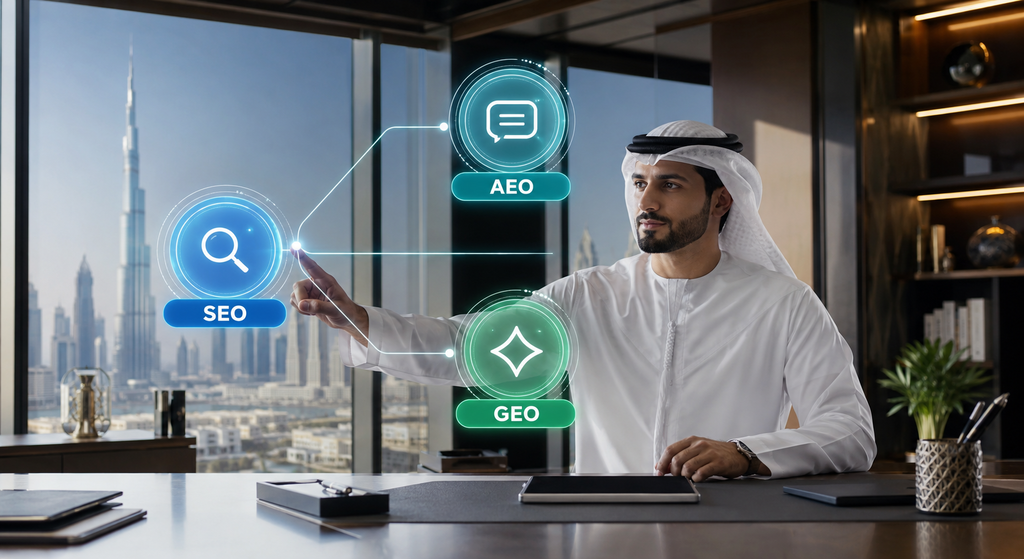
Search is no longer limited to a list of blue links.
A potential customer looking for a service in the UAE might still search on Google, but they may also ask a conversational question, read an AI-generated overview, use an AI assistant to compare options, or expect a direct answer without visiting several websites first.
For businesses, this creates an important shift.
Being visible online is no longer only about ranking a webpage for a keyword. Businesses increasingly need content that search engines can discover, understand and trust — while also making that information useful enough to appear within answer-based and generative search experiences.
This is where three terms are increasingly discussed:
SEO — Search Engine Optimization
AEO — Answer Engine Optimization
GEO — Generative Engine Optimization
They are often presented as three separate strategies. In reality, they are closely connected.
Google’s own 2026 guidance notes that AEO and GEO are terms commonly used for improving visibility in AI search experiences, while emphasizing that established SEO practices continue to provide the foundation for visibility in generative search.
For UAE businesses, therefore, the question should not be:
“Should we stop doing SEO and start doing GEO?”
A better question is:
“How should our search strategy evolve as people discover businesses through both traditional search results and AI-generated answers?” This guide explains that shift.
What Is SEO?
Search Engine Optimization is the process of improving a website so that search engines can discover, understand and present its pages to relevant users.
Traditional SEO usually focuses on areas such as:
- search intent
- keyword relevance
- website architecture
- title tags and meta descriptions
- internal linking
- page speed and mobile experience
- crawlability and indexing
- backlinks and authority
- local search visibility
- useful, relevant content
For example, consider a UAE company offering accounting services.
A potential customer may search:
“corporate tax consultant Dubai”
An SEO strategy would help the company’s relevant service page become understandable and competitive for searches related to that need.
But modern search behaviour is becoming more conversational.
Instead of typing a short keyword, the same customer might ask:
“What should a small company in Dubai check before choosing a corporate tax consultant?”
The second search requires more than keyword placement.
The search system needs to understand the question, identify useful information and determine which sources are sufficiently relevant and trustworthy to support an answer. That is where AEO becomes important.
What Is AEO?
Answer Engine Optimization (AEO) refers to structuring and improving information so that search and answer systems can easily understand it and use it when responding to questions.
AEO focuses heavily on answerability.
Consider this question:
How long does SEO take for a new UAE business?
A weak page might contain several paragraphs discussing digital marketing without directly addressing the question.
A better answer-oriented page could explain immediately that the timeframe depends on factors such as the site’s current authority, competition, technical condition, target market and content strategy.
It can then explain each factor in greater detail.
The goal is not simply to make the content shorter.
The goal is to make the relationship between the question and answer clear.
AEO-friendly content often includes:
- descriptive headings
- clearly answered questions
- concise explanations followed by deeper context
- logically organised sections
- useful FAQs
- comparison tables where appropriate
- definitions written in natural language
- supporting evidence
- relevant internal links
AEO is therefore less about finding a secret technical trick and more about making information easier for both humans and machines to interpret.
What Is GEO?
Generative Engine Optimization (GEO) is a term used for improving the likelihood that a brand, website or piece of information can be discovered and considered within AI-generated search experiences.
Traditional search often worked roughly like this:
Search → Results → Website → Information
Generative search can create another journey:
Question → AI-generated response → Supporting sources → Website
The difference is important.
The user may receive part of the information they need before clicking any website.
That means a business should think not only about ranking positions but also about whether its website provides information that can contribute meaningfully to an AI-generated response.
Google explains that its generative search systems may perform multiple related searches — a process it describes as query fan-out — retrieve relevant information from different pages and then generate a response supported by links to web sources.
This means that a page does not necessarily need to match only one exact keyword. It needs to contribute useful information to the broader topic being explored.
SEO vs AEO vs GEO: The Difference
The easiest way to understand the three is through the objective behind each approach.
| Approach | Primary Focus | Typical Goal |
| SEO | Search visibility | Help relevant webpages appear in search results |
| AEO | Answerability | Make information easy to understand and use when answering questions |
| GEO | Generative search visibility | Improve the ability of content and brand information to contribute to AI-generated search experiences |
But businesses should avoid treating this table as three independent marketing departments.
The three approaches overlap significantly.
A technically weak website will struggle regardless of whether someone calls the strategy SEO or GEO.
Content that lacks expertise will not suddenly become useful because an FAQ section is added.
And a website with poor crawlability cannot expect generative systems that rely on web search to consistently discover its information.
That is why SEO remains the foundation.
Does GEO Replace SEO?
No.
This is one of the most important misconceptions businesses should avoid.
Google’s current guidance specifically states that established SEO best practices remain relevant to generative AI search and describes AEO and GEO as terminology used around optimizing for these experiences rather than replacements for SEO itself.
Technical SEO still matters.
Crawlable pages still matter.
Clear website architecture still matters.
Helpful content still matters.
Internal linking still matters.
Authority still matters.
Search intent still matters.
The difference is that businesses now need to think beyond:
“How can this page rank for this keyword?”
They also need to ask:
“What information does this page contribute to the subject?”
That distinction changes how good content should be planned.
Why This Matters for UAE Businesses
The UAE is a highly competitive business environment.
In sectors such as:
- real estate
- professional services
- healthcare
- business setup
- finance
- hospitality
- construction
- e-commerce
- technology
- legal and consulting services
customers can choose between numerous providers offering similar services.
As AI-assisted discovery grows, simply having a website containing generic descriptions such as:
“We provide high-quality solutions tailored to your needs.”
adds very little value.
Hundreds of competitors can say exactly the same thing.
Instead, businesses need to demonstrate what they actually know.
For example, a Dubai web development company could publish content explaining:
- what UAE businesses should prepare before beginning a website project
- how website requirements differ between service businesses and e-commerce companies
- common reasons UAE websites generate traffic but few enquiries
- what should be checked before redesigning an existing website
- how multilingual website architecture should be planned
This type of content builds a useful information footprint around the company’s expertise.
That is far more valuable than producing dozens of shallow pages targeting slightly different keyword variations.
The Shift From Keywords to Topics and Questions
Keywords are not disappearing.
They remain useful because they reveal how people describe problems and services.
But modern search strategy should not stop at a keyword list.
Suppose a business targets:
“SEO agency Dubai.”
A traditional content strategy may create one service page around the keyword.
A broader search strategy would examine the entire decision process around that search.
Potential customers may also want to know:
- What does an SEO agency actually do?
- How can I evaluate an SEO company?
- Should a new UAE business invest in SEO or Google Ads first?
- Why is my website receiving impressions but no clicks?
- What is local SEO?
- How long does SEO normally require?
- Does SEO still matter with AI search?
- Can AI assistants discover my company?
- How should SEO performance be measured?
Together, these questions create topic depth.
And topic depth helps a website demonstrate that it genuinely covers an area rather than merely repeating a commercial keyword.
What Makes Content Useful for SEO, AEO and GEO?
There is no proven formula that guarantees an AI platform will cite or recommend a particular website.
Businesses should therefore be cautious about agencies or tools promising guaranteed AI visibility.
Google similarly warns that third-party SEO, AEO or GEO services cannot guarantee performance or access Google’s internal ranking information.
However, several sound practices improve the overall quality and machine-understandability of a website.
1. Publish Information That Adds Something New
This may be the biggest opportunity for businesses.
The internet already contains countless articles explaining:
“What is SEO?”
Producing another version using slightly different wording adds little value.
Instead, contribute knowledge from your actual field.
A digital marketing company might explain:
- patterns seen while auditing SME websites
- common measurement mistakes
- differences between lead volume and lead quality
- situations where paid advertising should not be the first marketing investment
- practical challenges of local search visibility
Google’s generative AI guidance specifically encourages valuable, unique and non-commodity content, including perspectives based on real knowledge or experience rather than simply repeating existing information.
2. Answer the Real Question Early
Do not make users read 600 words before receiving the information promised by the heading.
If the heading asks:
“Does GEO replace SEO?”
answer it immediately.
Then explain why.
This improves readability and makes individual sections easier to understand independently.
3. Build Strong Topic Coverage
One large article cannot answer every question customers have.
Create connected resources around your important service areas.
For example:
Main topic:
SEO Services
Supporting topics:
- Local SEO
- Technical SEO
- On-page SEO
- SEO vs paid advertising
- Google AI Overviews
- AEO
- GEO
- content strategy
- search intent
- topical authority
- conversion optimization
Link related articles together naturally.
This creates a clearer information architecture for both users and search engines.
4. Make Your Expertise Visible
Businesses often hide the information that actually makes them credible.
A strong website should clearly communicate:
- who provides the service
- what the company specialises in
- where it operates
- what industries it understands
- how its process works
- what problems it typically solves
Google’s people-first content guidance encourages clear authorship and content demonstrating genuine experience, expertise, authority and trust.
Generic content cannot substitute for genuine expertise.
5. Use Structured Data Correctly
Structured data provides search engines with explicit information about what a page contains.
Depending on the website and page, appropriate structured data may help describe information such as:
- organisations
- articles
- breadcrumbs
- products
- local businesses
- events
- other supported content types
Google explains that structured data can help it understand page content and may make eligible pages available for richer search appearances.
However, structured data is not an AI visibility shortcut.
Adding schema does not guarantee rankings, rich results or citations in AI-generated answers. Google explicitly states that structured data eligibility does not guarantee a particular search appearance.
Use it because it accurately describes the content — not because someone promises it will “hack GEO.”
6. Strengthen Brand and Business Information
Search systems should not have to guess who your company is.
Maintain consistent business information across:
- your website
- service pages
- About page
- contact information
- business profiles
- reputable industry listings
- relevant external mentions
Clear brand signals become increasingly important when search systems need to understand relationships between businesses, services, people and locations.
For a UAE company, geographical clarity matters as well.
A business operating in Dubai should clearly explain whether it serves:
- Dubai only
- specific Emirates
- the entire UAE
- GCC markets
- international clients
Avoid creating dozens of artificial location pages with almost identical content.
Create genuinely useful local information instead.
7. Don’t Write for AI at the Expense of People
This is an easy mistake.
Once marketers hear about GEO, they may begin producing unnatural pages designed entirely around machines:
- excessive FAQs
- repetitive definitions
- dozens of nearly identical headings
- forced keyword variations
- robotic summaries
- unnecessary schema
- shallow AI-generated pages
That misses the point.
Google’s current guidance continues to prioritise helpful, reliable, people-first content rather than content created primarily to manipulate search systems.
Your customer should still be the first audience.
AI discoverability should be a consequence of making your information clearer and more valuable — not an excuse to make the page less useful.
A Practical Example for a UAE Business
Imagine a commercial cleaning company in Dubai.
Weak strategy
The website contains:
Homepage
About Us
Cleaning Services Dubai
Contact Us
Most pages contain variations of:
We are the leading cleaning company providing high-quality and affordable services.
There is very little information for a search engine or prospective customer to evaluate.
Stronger strategy
The company’s service page clearly explains its commercial cleaning services.
It then develops useful supporting content such as:
- Office Cleaning vs Deep Cleaning: What Does Your Business Need?
- How Often Should a Dubai Office Schedule Deep Cleaning?
- What Should Businesses Check Before Hiring a Commercial Cleaning Company?
- Cleaning Requirements for Offices, Retail Spaces and Warehouses
- Questions to Ask Before Signing a Commercial Cleaning Contract
The company also maintains clear contact information, service locations, company details, relevant structured data and internal links between related resources.
Now the website has become more than an online brochure.
It has become an information resource connected to a genuine business.
That is the direction businesses should think about when discussing SEO, AEO and GEO.
SEO Metrics Will Still Matter — But Measurement Needs to Expand
For years, businesses often focused heavily on:
- rankings
- organic sessions
- impressions
- clicks
Those metrics remain useful.
But marketers should increasingly evaluate search performance more broadly.
Consider tracking:
- qualified organic enquiries
- non-branded search visibility
- branded search demand
- conversions from organic landing pages
- visibility across important topic clusters
- referral traffic
- Search Console performance
- local search performance
- pages receiving meaningful engagement
Google also includes traffic from AI Mode within Search Console’s overall performance reporting, reinforcing that AI-search discovery and traditional search measurement are becoming increasingly connected.
Businesses should therefore avoid creating an entirely separate universe of questionable “GEO metrics” without understanding what those measurements actually represent.
Common AEO and GEO Mistakes Businesses Should Avoid
Treating GEO as a replacement for SEO
If the technical and content foundations of the website are weak, changing terminology will not fix them.
Creating hundreds of AI-generated articles
Volume without expertise creates very little competitive advantage.
Writing only definitions
Definitions are useful, but businesses should also provide practical insights, comparisons, processes and original observations.
Expecting schema to guarantee AI citations
Structured data can improve machine understanding but does not guarantee visibility.
Optimizing only for ChatGPT
AI discovery is broader than one platform. Businesses should build a strong, open and useful web presence rather than chasing one interface.
Ignoring conversion quality
Visibility has little business value if visitors cannot understand the offer or take the next step.
SEO, AEO and GEO should eventually support business outcomes — not simply marketing terminology.
What Should UAE Businesses Do in 2026?
Businesses do not need to rebuild their entire marketing strategy because a new acronym has appeared.
Start with fundamentals.
Strengthen your existing SEO foundation.
Make sure important pages can be crawled, indexed and understood.
Improve your important service pages.
Clearly explain what you provide, who the service is for, where you operate and what problems you solve.
Build topic depth.
Develop useful supporting content around genuine customer questions.
Make answers clearer.
Use descriptive headings and answer important questions directly.
Add original expertise.
Publish information competitors cannot easily reproduce simply by rewriting the first page of Google results.
Improve trust signals.
Use clear company information, authorship, contact details and credible supporting information.
Connect related content.
Use sensible internal links between service pages and educational resources.
Measure business outcomes.
Do not judge success from rankings alone.
SEO, AEO and GEO Should Work Together
SEO, AEO and GEO are best understood as different perspectives on the same increasingly complex search environment.
SEO creates the foundation for discoverability.
AEO makes information easier to extract and answer from.
GEO considers how that information may participate in generative search experiences.
But none removes the need for a useful website.
The businesses most likely to adapt successfully are not necessarily those using the newest terminology first.
They are the businesses building digital assets that are:
technically accessible, clearly structured, genuinely useful, trustworthy and distinctive enough to deserve visibility.
That principle worked before generative search.
It matters even more now.
Final Takeaway
The future of search is not simply SEO versus AEO versus GEO.
It is about becoming discoverable wherever customers look for information.
For a UAE business in 2026, that may mean appearing in traditional organic results, local search, AI-generated search experiences, answer systems and other discovery platforms.
The strategy therefore needs to evolve from:
“How do we rank this keyword?”
toward:
“How do we become a reliable and useful source on the subjects our customers care about?”
Companies that make that transition will be better positioned for search behaviour that continues to change — without abandoning the SEO fundamentals that still make digital visibility possible.
speak with Prolific’s digital marketing team
Disclaimer
This article is provided for informational and educational purposes only. Search technologies, ranking systems and AI-powered search experiences continue to evolve, and visibility cannot be guaranteed through any single SEO, AEO or GEO technique. Businesses should evaluate strategies according to their website, audience, industry and marketing objectives.