 UAE Trusted

What Makes a High-Converting
Discover the essential elements of a high-converting business website in 2026, from mobile-first design and speed to trust signals, clear CTAs and user experience.

Business Website in 2026?
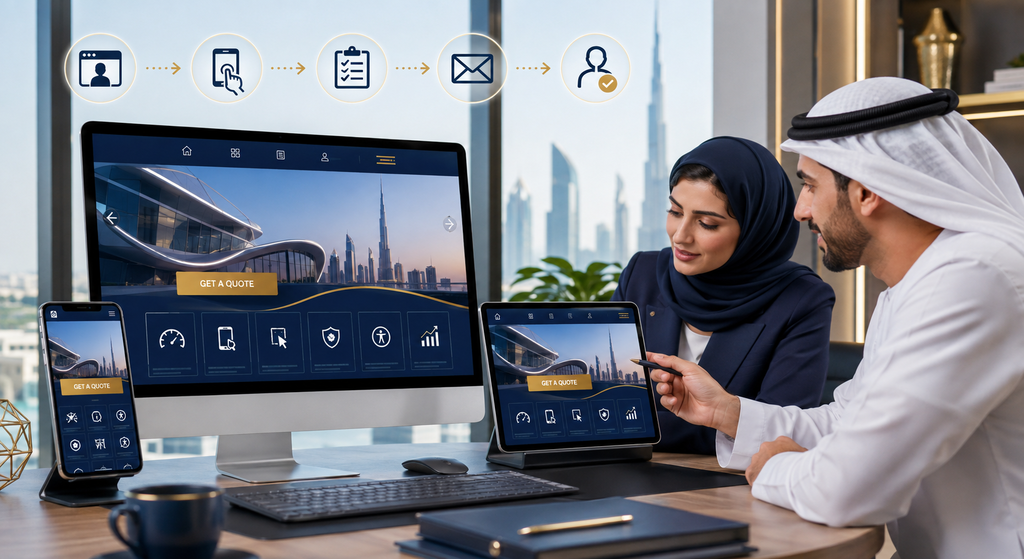
In today’s digital-first world, your website is no longer just an ‘online presence’ — it is the very first salesperson your business puts in front of a customer. People visit your website before they call you, before they walk into your store, and often before they even decide whether your business is worth trusting. If what they find there feels outdated, loads slowly, or is confusing to navigate, they leave within seconds — straight into the arms of a competitor. This is exactly why building a high-converting website in 2026 is no longer a luxury; it has become a basic requirement for business survival.
This guide takes a deep, practical look at why websites matter more than ever, the clear warning signs of an outdated site, the exact elements a modern high-converting website needs, the mistakes most businesses make, and a step-by-step approach to upgrading your website the right way. Whether you run a small local business or a growing company, this blog will help you understand what a website needs to look like — and function like — in 2026.
1. Why Is a Website So Important Today?
There was a time when businesses were known purely through their physical shop, office, or word of mouth. Today, almost every buying decision begins online — with a Google search, an Instagram profile, a Google Maps listing, or a direct website visit. Customers now research before they buy, compare before they commit, and judge credibility long before they ever speak to a salesperson. A professional website directly impacts several critical areas of a business:
- Trust and Credibility — A well-designed website signals to visitors that a business is genuine, established, and worth engaging with. An unprofessional site raises doubts, even if the actual product or service is excellent.
- 24×7 Availability — A website never closes — customers can explore your services, pricing, and offerings at 2 a.m. just as easily as at noon, without waiting for business hours.
- Cost-Effective Marketing — A well-built website keeps generating leads for years, while traditional advertising requires repeated spending just to stay visible.
- First Impressions — Research consistently shows that users decide within a few seconds whether to stay on a page or leave — and that decision often shapes their opinion of the entire brand.
- Wider Reach Beyond Local Boundaries — A website allows a business to be discovered by customers outside their immediate neighbourhood, city, or even country, opening doors that physical presence alone cannot.
- A Central Hub for All Marketing Efforts — Every social media post, ad campaign, and referral eventually points back to the website — making it the foundation on which all other marketing stands.
This is why a website should never be treated as a simple ‘digital brochure.’ It should be seen as an active, working sales and trust-building tool that operates around the clock, even while you sleep.
2. How Customer Expectations Have Changed
A decade ago, simply having a website was enough to stand out. Today, customers compare every business they encounter online against the best digital experiences they use daily — fast apps, seamless checkouts, and beautifully designed platforms. This shift means that even small, local businesses are now judged by big-brand standards. A slow, cluttered, or confusing website doesn’t just look ‘a bit old’ anymore — it actively signals that a business might be outdated in how it operates as well.
Modern customers expect instant answers, mobile-friendly browsing, transparent pricing or information, genuine reviews, and a quick, frictionless way to get in touch. Meeting these expectations isn’t about flashy design alone — it’s about respecting the customer’s time and attention
3. Warning Signs of an Outdated Website
Many business owners don’t realize that their own website may be quietly pushing customers away. Here are the most common warning signs that indicate it’s time for an update:
- Poor mobile experience — Over 70% of web traffic now comes from mobile devices; if the layout looks broken, text is too small, or buttons are hard to tap on a phone, visitors leave immediately.
- Slow loading speed — Pages that take longer than a few seconds to load see a sharp rise in visitors abandoning the site before it even finishes loading.
- Old-fashioned design and fonts — Cluttered layouts, outdated visual styles, tiny text blocks, and design trends from a decade ago no longer feel professional or trustworthy.
- No clear Call-To-Action (CTA) — If buttons like ‘Contact Us’ or ‘Buy Now’ are hidden, unclear, or missing altogether, conversions drop dramatically.
- Outdated content — Old information, broken links, expired offers, or a copyright date stuck years in the past all create a negative impression.
- Difficult navigation — If visitors can’t find what they’re looking for within a few clicks, they assume the business itself is disorganized.
- No social proof — Missing reviews, testimonials, or portfolio work makes it harder for new visitors to trust an unfamiliar business.
- Not secure — A missing padlock icon or lack of HTTPS makes browsers flag the site as ‘not secure,’ scaring away cautious visitors instantly.
4. The Essential Elements of a Modern, High-Converting Website in 2026
Building a website that actually converts visitors into customers requires far more than good looks. Below is a detailed breakdown of every element that matters in 2026.
A. Clean and Modern Visual Design
Minimal design, generous white space, and a consistent color scheme make a website feel professional and calm rather than overwhelming. Every section should have one clear purpose, with visual hierarchy guiding the eye naturally from headline to content to action. Overly busy pages with too many competing elements confuse visitors and reduce conversions.
B. A Mobile-First Approach
Websites today should be designed for mobile screens first, then adapted for desktop — not the other way around. Buttons, text sizing, spacing, and images all need to be touch-friendly and easy to interact with using just a thumb. A site that merely ‘shrinks’ on mobile without being truly optimized will always underperform.
C. Fast Loading Speed
Optimizing images, minimizing unnecessary scripts, using efficient code, and choosing reliable hosting all improve loading speed. Speed isn’t just about user experience — it is also a major ranking factor for search engines, meaning a slow site can hurt visibility as well as conversions.
D. Clear and Strategic CTAs
On every page, visitors should immediately know what to do next — whether that’s ‘Get a Free Quote,’ ‘Message Us on WhatsApp,’ ‘Book an Appointment,’ or ‘Add to Cart.’ CTA buttons should stand out with contrasting colors, use action-oriented language, and appear at natural decision points throughout the page — not just buried at the bottom.
E. Strong, Benefit-Focused Content
Great design can only do so much if the words on the page don’t clearly explain what a business offers and why it matters. Content should speak directly to the visitor’s problem, highlight real benefits rather than vague claims, and guide them naturally toward taking action. Short paragraphs, clear headings, and simple language almost always outperform dense, jargon-heavy text.
F. Trust-Building Elements
Customer reviews, star ratings, certifications, media mentions, case studies, and real photos of the team, workspace, or product all build trust. People naturally gravitate toward businesses that openly showcase their credibility, track record, and real human presence behind the brand.
G. SEO-Friendly Structure
Proper heading structure, descriptive meta titles and descriptions, optimized images with alt text, clean URLs, and strong page performance all help search engines understand and rank a website higher — which naturally increases organic (free) traffic over time without ongoing ad spend.
H. Personalized and Interactive Experience
Websites in 2026 are no longer just static pages. Live chat widgets, chatbots, personalized product or content recommendations, and interactive tools such as calculators or quizzes significantly improve engagement and the time visitors spend exploring a site.
I. Security and Reliability
SSL certificates, secure payment gateways, regular backups, and protection against spam or malicious traffic don’t just protect data — they also give customers the confidence that their personal and payment information is safe with your business.
J. Easy, Intuitive Navigation
A visitor should never have to think about where to click next. Clear menus, logical page structure, breadcrumbs on larger sites, and a visible search bar all help users find what they need quickly — reducing frustration and bounce rates.
K. High-Quality Visuals and Video
Professional photography, product images, and short explainer or demo videos help visitors understand an offering far faster than text alone. Video in particular has become one of the most effective tools for building an emotional connection and explaining value quickly.
L. Local SEO and Map Integration
For businesses serving a specific city or region, an embedded map, clear address and contact details, and consistent local business listings help both customers and search engines understand exactly where and how to reach the business.
M. Analytics and Continuous Improvement
A high-converting website is never truly ‘finished.’ Tools that track visitor behaviour — where they click, where they drop off, and what they search for — allow a business to continuously refine the site based on real data rather than guesswork.
N. Accessibility for All Users
Good color contrast, readable font sizes, keyboard navigation, and proper labelling ensure that people with visual, motor, or other impairments can still use the website comfortably. Accessibility isn’t just an ethical consideration — it also widens the pool of potential customers a business can reach.
5. Common Mistakes Businesses Make With Their Websites
- Treating the website as a one-time project — Launching a site and never updating the content, offers, or design for years afterward.
- Prioritizing looks over usability — Choosing flashy animations or trendy effects that slow the site down or confuse navigation.
- Ignoring mobile users — Designing primarily for desktop and treating the mobile version as an afterthought.
- Overloading pages with information — Trying to say everything on the homepage instead of guiding visitors step by step.
- Weak or missing CTAs — Leaving visitors interested but with no clear, easy next step to take.
- No clear differentiation — Failing to explain why a customer should choose this business over a competitor.
- Neglecting page speed — Using large, unoptimized images and heavy plugins that slow everything down.
- Skipping analytics — Never checking how visitors actually behave on the site, and therefore never improving it.
6. A Practical, Step-by-Step Approach to Upgrading Your Website
- Audit the current website — Review design, speed, mobile experience, and content honestly — ideally by asking someone outside the business to test it.
- Define clear goals — Decide exactly what you want visitors to do: call, message, book, buy, or fill a form — and design around that goal.
- Plan the content and structure first — Map out pages and key messages before jumping into visual design, so the site has a clear, logical flow.
- Choose a clean, modern design direction — Focus on simplicity, strong typography, and a consistent color palette that reflects the brand.
- Optimize for mobile and speed from day one — Test on real phones and slower internet connections, not just a fast office Wi-Fi connection.
- Add trust-building elements — Integrate reviews, certifications, and real photos as part of the core design, not as an afterthought.
- Set up basic analytics — Track visitor behaviour from launch day so improvements can be based on real data.
- Review and refine regularly — Treat the website as an ongoing project — updating content, offers, and design elements every few months.
7. Emerging Trends Shaping Websites in 2026
As technology and user behaviour continue to evolve, a few clear trends are shaping what ‘modern’ means for business websites this year:
- AI-driven personalization — Websites increasingly tailor content, recommendations, and messaging based on visitor behaviour in real time.
- Voice and conversational search — More users are phrasing searches as natural questions, making conversational, clearly structured content increasingly important.
- Micro-interactions and subtle animation — Small, purposeful animations — like a button gently highlighting on hover — improve engagement without slowing the site down.
- Sustainability and performance-conscious design — Leaner, faster-loading websites are increasingly valued, both for user experience and reduced energy consumption.
- Integrated messaging and instant communication — Direct WhatsApp, live chat, or click-to-call options are becoming standard rather than optional.
8. Attractive vs. Effective — Why Both Matter
Many people assume that simply looking good is enough, but a truly high-converting website needs a careful balance between design and functionality. An attractive design grabs attention and builds an initial positive impression, while smart structure, clear messaging, and thoughtful CTAs turn that attention into action — an inquiry, a call, a booking, or a purchase. A beautiful website that confuses visitors is just as ineffective as a fast, functional website that looks unprofessional. The two must work together, not compete with each other.
Frequently Asked Questions
Q.How often should a business update its website?
A. Content, offers, and images should be reviewed every few months, while the overall design and structure typically benefit from a deeper refresh every couple of years, or sooner if user behaviour or business needs change significantly.
Q. Is a beautiful design enough to guarantee conversions?
A. No. Design attracts attention, but clear messaging, strong CTAs, trust signals, and fast performance are what actually turn that attention into real inquiries or sales.
Q. Do small or local businesses really need a high-converting website?
A. Yes — often even more so, since customers frequently research local businesses online before ever visiting in person or making a call, and a strong first impression can be the deciding factor.
Q. What is the single biggest factor in a website’s conversion rate?
A. There isn’t one single factor — speed, mobile experience, clarity of messaging, and trust signals all work together, and weakness in any one of these areas can significantly hold back the others.
Conclusion — A Website Is an Investment, Not an Expense
In 2026, a large part of a business’s success depends on its online presence. A modern, fast, and user-friendly website doesn’t just look good — it actively generates leads, builds trust, and keeps a business ahead of its competitors. It works quietly in the background, welcoming visitors, answering their questions, and guiding them toward becoming customers, twenty-four hours a day.
So if your website feels old, slow, or confusing, updating it isn’t just a design change — it’s a smart, forward-looking business decision. The businesses that treat their website as a living, evolving asset — rather than a one-time task to check off a list — are the ones that will continue to earn trust, attention, and revenue online for years to come.