 UAE Trusted
SEO, Paid Ads or Social Media: Where Should a UAE SME Start?
Discover when UAE businesses should invest in SEO, paid ads and social media together, and how an integrated strategy can improve visibility, lead quality and long-term marketing performance.

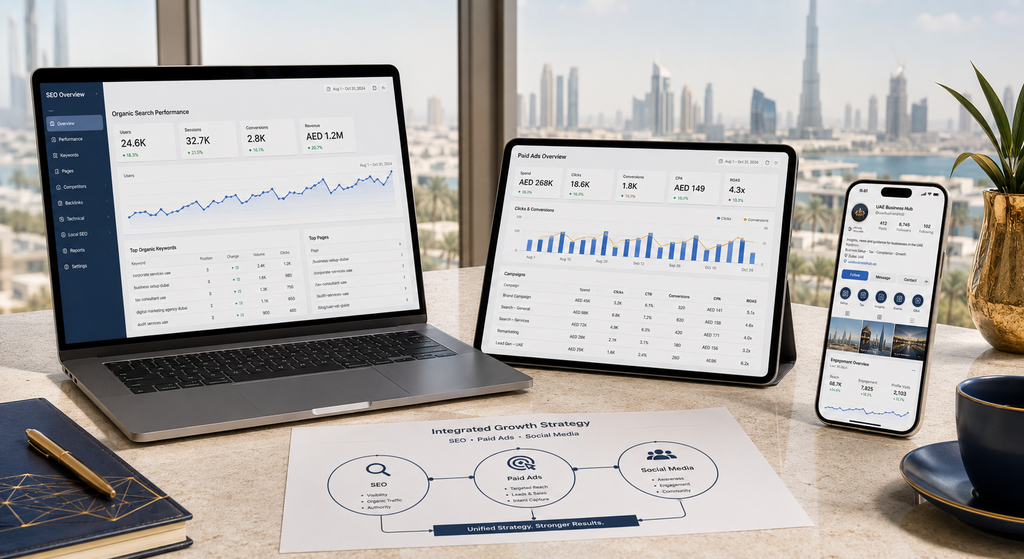
A UAE SME deciding where to invest in digital marketing will usually encounter three recommendations: improve SEO, run paid advertisements or become more active on social media.
All three can support business growth, but they solve different problems.
SEO helps a business become discoverable when potential customers are actively searching. Paid advertising creates immediate visibility among a selected audience. Social media helps the business remain visible, communicate its expertise and build familiarity over time.
The right starting point therefore depends on what the business needs most: immediate enquiries, sustainable search visibility or stronger market awareness.
Why This Decision Matters for UAE SMEs
The UAE is a highly connected and competitive market. According to the Telecommunications and Digital Government Regulatory Authority’s Digital UAE Factsheet, the country had approximately 10 million active social media accounts, with average daily social media use reaching two hours and 20 minutes.
Search is equally important when customers are already considering a purchase. Google research reported that 77% of surveyed consumers in the UAE and Saudi Arabia used Google Search as their first touchpoint when looking for information across several product and service categories.
These figures do not mean every SME should immediately spend on every digital channel. They show that potential customers move between search engines, websites and social platforms before making decisions.
The challenge for an SME is to choose the channel that best matches its current business objective and buying process.
The Short Answer
A UAE SME should generally begin with:
- SEO when customers already search online for the service and the business wants to develop consistent, long-term visibility.
- Paid ads when the business needs enquiries quickly, is launching a time-sensitive offer or wants to test demand in a controlled market.
- Social media when trust, visual presentation, regular engagement or brand familiarity strongly influences the buying decision.
For many SMEs, the most practical approach is not choosing one channel permanently. It is choosing one as the immediate priority while preparing the basic foundation for the other two.
Before Selecting a Channel, Fix the Marketing Foundation
SEO, paid advertising and social media cannot compensate for an unclear offer or a weak customer journey.
Before investing heavily in any channel, the business should be able to answer:
- Who is the intended customer?
- What problem does the service solve?
- Why should the customer consider this business?
- Which location or market does the company serve?
- What action should a potential customer take?
- Who will respond when an enquiry arrives?
- How will the business identify whether a lead is qualified?
The business should also have a functional website or landing page, clear service information, reliable contact options and basic enquiry tracking.
Without these elements, SEO can attract traffic that does not convert, ads can spend money on unsuitable clicks, and social media can generate attention without producing a clear next step.
Option One: Starting With SEO
For a UAE SME, this may involve optimising service pages, improving technical website performance, targeting location-based searches, publishing useful content and maintaining an accurate Google Business Profile.
When SEO Is the Right Starting Point
SEO is a suitable starting point when:
- Potential customers already search for the service on Google.
- The business serves a specific area such as Dubai, Abu Dhabi, Sharjah or Ajman.
- The service has consistent demand rather than a short promotional period.
- Customers normally research several providers before making contact.
- The company wants to reduce its long-term dependence on paid traffic.
- The website contains useful services but receives little relevant organic visibility.
SEO can be particularly valuable for clinics, consultancies, financial service providers, home service businesses, legal firms, property companies, training providers and B2B companies whose customers actively research solutions online.
What SEO Can Do Well
SEO helps a business appear during moments of active interest.
A person searching for “corporate bank account assistance UAE,” “SEO company in Dubai” or “commercial cleaning services in Abu Dhabi” is expressing a clearer need than someone who simply encounters an unrelated social media post.
A strong SEO strategy can help an SME:
- Reach people already looking for its services
- Build visibility for relevant local searches
- Create useful website pages around customer needs
- Strengthen credibility during customer research
- Develop traffic that does not depend entirely on continuous advertising spend
What SEO Cannot Do Immediately
SEO usually requires time to build meaningful results. A new website will not automatically compete with established businesses simply because keywords have been added to its pages.
Results depend on factors such as:
- Website quality and technical health
- Competition in the selected market
- Relevance and usefulness of the content
- Strength of the company’s local presence
- Website authority
- Consistency of optimisation
- Search engine crawling and indexing
SEO should therefore not be presented as an instant lead-generation solution. It is better suited to SMEs prepared to develop visibility steadily and maintain their website as a genuine business asset.
Option Two: Starting With Paid Ads
Google Search Ads can place a business in front of people actively searching for particular services. Meta Ads can reach audiences across Facebook and Instagram based on interests, behaviour and engagement. LinkedIn advertising can help B2B companies reach professionals based on factors such as job role, company and industry.
When Paid Ads Are the Right Starting Point
Paid advertising may be the strongest initial choice when:
- The business needs to generate enquiries without waiting for organic rankings.
- A new service or location is being launched.
- The company wants to test whether a market responds to a particular offer.
- The promotion has a defined start and end date.
- Search demand already exists for the service.
- The business has a landing page and a team ready to handle enquiries.
- Lead sources and conversions can be tracked properly.
For example, a UAE SME launching a new service in Dubai could use a focused Google Search campaign to test relevant search terms. The response can provide early insight into customer demand, common enquiries and conversion behaviour.
What Paid Ads Can Do Well
Paid advertising offers speed and control.
Campaigns can be directed towards selected locations, devices, audience groups, search terms and schedules. Businesses can also test different messages and landing pages without waiting for organic rankings to develop.
Paid ads can help an SME:
- Generate visibility quickly
- Target people showing purchase intent
- Test demand for a service
- Promote time-sensitive offers
- Retarget previous website visitors
- Measure enquiries linked to particular campaigns
- Gather information that can support future SEO and content decisions
What Paid Ads Cannot Fix
Advertising cannot repair a weak offer, confusing website or poor sales process.
A campaign may attract clicks but still fail if:
- The landing page does not match the advertisement.
- The service is not explained clearly.
- The website appears unreliable on mobile devices.
- The enquiry form asks for too much information.
- Calls and messages are answered slowly.
- Targeting is too broad.
- The business has not defined a qualified lead.
- Conversion tracking is missing or inaccurate.
Paid advertising can produce data quickly, but it can also waste money quickly. An SME should not start by advertising every service to every person in the UAE. A smaller, tightly defined campaign is usually more useful for testing what works.
Option Three: Starting With Social Media
For many customers, a company’s social profile is part of the verification process. They may discover the business elsewhere and visit its social page to judge whether it appears active, credible and relevant.
When Social Media Is the Right Starting Point
Social media may deserve priority when:
- The product or service is visually led.
- Customers need to see examples before making contact.
- Trust and familiarity strongly influence the decision.
- The business depends on local community engagement.
- New offers, stock or projects are introduced frequently.
- Customers spend time comparing brands on Instagram, Facebook, LinkedIn or TikTok.
- The company has expertise or behind-the-scenes work worth demonstrating.
Restaurants, beauty businesses, real estate companies, retailers, interior designers, hospitality brands, event companies and lifestyle businesses can often benefit from a strong visual presence.
For B2B companies, LinkedIn may be more relevant than highly visual consumer platforms. Content can be used to demonstrate expertise, explain complex services and maintain visibility among decision-makers.
What Social Media Can Do Well
Social media can help a business:
- Present its work and capabilities
- Build recognition within a defined audience
- Share customer experiences and project examples
- Explain services in an accessible format
- Communicate updates quickly
- Create additional touchpoints before a sales conversation
- Support paid retargeting and audience development
It is also useful for answering recurring customer questions and showing that the company is active.
What Social Media Cannot Guarantee
Regular posting does not automatically create leads.
A page may receive likes, views and followers without reaching people who are likely to buy. Engagement can be encouraging, but it should not be treated as the only measure of business performance.
An SME should evaluate whether social media activity contributes to:
- Relevant profile visits
- Website visits
- Direct messages from potential customers
- WhatsApp conversations
- Bookings or appointments
- Qualified enquiries
- Assisted conversions
- Repeat customer engagement
Social media works best when content is connected to a clear audience, business objective and next step.
SEO vs Paid Ads vs Social Media: A Practical Comparison
| Area | SEO | Paid Ads | Social Media |
| Primary purpose | Capture relevant search demand and build organic visibility | Generate immediate, targeted visibility | Build awareness, familiarity and engagement |
| Speed | Usually gradual | can begin generating traffic quickly | Visibility can grow steadily, but consistency is required |
| Traffic source | Organic search results | Paid placements | Organic and paid social platforms |
| Best suited for | Services people actively search for | Time-sensitive campaigns and demand testing | Visual, trust-led and community-driven businesses |
| Cost pattern | Requires ongoing optimisation and content work | Requires an active advertising budget | Requires consistent content, management and sometimes paid promotion |
| Main strength | Long-term discoverability | Speed and targeting control | Brand familiarity and customer interaction |
| Main risk | Expecting immediate rankings | Paying for irrelevant clicks or leads | Focusing on engagement without business outcomes |
| Stops when activity stops? | Existing visibility may continue, although maintenance is necessary | Traffic normally declines when spending stops | Reach may decline when publishing and engagement stop |
Which Channel Fits Different UAE SME Situations?
A New Local Service Business
A newly established local service business should first create a professional website, optimise its Google Business Profile and establish basic local SEO.
If immediate enquiries are required, a limited Google Search campaign can run alongside this work. Social media should support credibility, but it may not need to be the first major investment unless the service is visually driven.
Priority: Local SEO supported by focused search advertising.
An E-Commerce or Consumer Product Business
A consumer brand may need strong product presentation, social proof and repeat visibility. Social media content and paid social campaigns can support discovery, while SEO can improve product and category visibility over time.
The business should avoid depending only on organic social reach. Website conversion, product feeds, remarketing and customer retention also matter.
Priority: Social media and paid campaigns, with SEO developed in parallel.
A B2B Professional Service Company
B2B customers often research carefully, compare providers and involve more than one decision-maker.
The company should have clear service pages, useful case studies and content that answers commercial questions. SEO can capture active search demand, while LinkedIn can help the company remain visible among relevant professionals.
Highly focused Google Ads may also be useful when there is sufficient search demand for the service.
Priority: SEO and authority-building content, supported by selective paid search or LinkedIn activity.
A Business Launching a Time-Sensitive Offer
SEO is unlikely to be the only solution when an offer must produce responses within a short period.
A dedicated landing page and paid campaign can provide faster visibility. Social media and email communication can support the campaign if the business already has a relevant audience.
Priority: Paid ads supported by a campaign-specific landing page.
A Business With Website Traffic but Few Enquiries
This business may not need more traffic immediately.
It should first examine whether the existing visitors are relevant and whether the website provides a clear route to enquiry. Service messaging, landing-page structure, contact options, lead forms and conversion tracking may need attention.
Increasing advertising before fixing these problems could increase expenditure without improving results.
Priority: Conversion review before expanding SEO, advertising or social activity.
A Business With Strong Referrals but Little Online Visibility
A referral-led business already has evidence that customers value its work. Its first digital priority should be making the company easier to verify online.
A credible website, Google Business Profile, service pages, reviews and professional social presence can strengthen the referral journey. SEO can then extend visibility beyond the existing network.
Priority: Website credibility and SEO foundation.
A Sensible Starting Sequence for UAE SMEs
For many SMEs, the following sequence is more practical than trying to launch every channel at once.
Step 1: Establish the Basic Digital Foundation
- The company website
- Core service pages
- Mobile usability
- Contact forms and WhatsApp access
- Google Business Profile, where relevant
- Analytics and conversion tracking
- Basic social profiles
- Clear brand and service messaging
Step 2: Identify the Immediate Business Need
- Immediate enquiries
- Long-term discoverability
- Brand awareness
- Local visibility
- Product sales
- Appointment bookings
- Market testing
- Customer retention
Step 3: Choose One Primary Channel
Select the channel with the clearest connection to the objective.
That may be SEO for sustainable search visibility, Google Ads for immediate high-intent traffic or social media for a visual and trust-led customer journey.
Focusing on one primary channel makes it easier to maintain quality and understand performance.
Step 4: Use the Other Channels as Support
Choosing a primary channel does not mean ignoring everything else.
A business prioritising SEO should still maintain credible social profiles. A company running ads should still improve its organic website content. A social-first brand should still ensure that customers can find accurate information through search.
The channels should support one another without competing for an SME’s limited time and budget.
Step 5: Measure Business Outcomes
Performance should be assessed beyond impressions, clicks and follower counts.
Useful indicators may include:
- Qualified enquiries
- Cost per qualified lead
- Calls and WhatsApp conversations
- Appointment bookings
- Proposal opportunities
- Lead-to-customer conversion rate
- Revenue influenced by the campaign
- Returning website visitors
- Organic visibility for commercially relevant searches
Should a UAE SME Use All Three?
Eventually, many SMEs can benefit from a combination of SEO, paid ads and social media.
SEO can capture ongoing search demand. Paid ads can support immediate campaigns and reach audiences the business has not yet acquired organically. Social media can reinforce trust and keep the brand visible between buying decisions.
The problem begins when a business divides a limited budget across too many channels without doing any of them properly.
A small business does not need to be everywhere. It needs to be present where its customers are most likely to discover, evaluate and contact it.
Common Mistakes to Avoid
Starting Paid Ads Without a Suitable Landing Page
Sending all advertisement traffic to a general homepage makes it harder for visitors to find the information promised in the ad. Each important campaign should direct users to a relevant page with a clear next step.
Expecting SEO to Produce Immediate Leads
SEO requires consistent work and realistic expectations. Businesses needing urgent enquiries may need paid campaigns while their organic presence develops.
Posting on Social Media Without a Strategy
Publishing frequently is not the same as communicating effectively. Content should address customer needs, build trust or support a specific business objective.
Measuring Every Channel in the Same Way
SEO, paid ads and social media influence different stages of the customer journey. One may create the initial discovery, another may build confidence, and a third may capture the final enquiry.
Copying Competitors’ Channel Choices
A competitor’s strategy may reflect a different budget, audience, business model or stage of growth. SMEs should make decisions using their own objectives, data and customer behaviour.
So, Where Should a UAE SME Start?
There is no single channel that is automatically right for every SME.
Start with SEO if potential customers actively search for the service and the business wants to establish durable visibility.
Start with paid ads if the company needs faster market feedback or immediate opportunities and already has a strong landing page and follow-up process.
Start with social media if the buying decision depends heavily on visual presentation, community, trust or repeated brand exposure.
If the business is still unclear about its audience, message or offer, it should begin there before committing heavily to any channel.
A well-chosen channel can support growth. A well-connected strategy—built around the customer journey—can make that growth more sustainable. At Prolific Enterprises, we help UAE SMEs determine which digital channels fit their goals, audience and stage of growth. Our services include SEO and Local SEO, Google and Meta advertising, social media marketing, lead generation, website and landing-page development, and conversion-focused digital strategy.
Frequently Asked Questions
Is SEO better than paid advertising for a small business?
Neither is universally better. SEO is suited to building longer-term search visibility, while paid advertising is useful for faster reach and testing. The right choice depends on demand, competition, timing and business objectives.
Can an SME generate leads only through social media?
It is possible in some industries, particularly when the product is visual or community driven. However, relying on one platform creates risk. A website, search presence and owned customer data provide a stronger foundation.
Should a new UAE business run Google Ads immediately?
Google Ads can be useful if people already search for the service and the business has a relevant landing page, tracking system and enquiry follow-up process. It should begin with controlled targeting rather than a broad campaign.
Does an SME need a website before starting social media?
A business can establish social profiles first, but a professional website gives customers a more reliable place to review services, submit enquiries and verify the company. It also supports SEO, advertising and measurement.
How long should a business test a marketing channel?
There is no reliable universal test period. It depends on the available demand, sales cycle, traffic volume, campaign budget and conversion activity. The test should collect enough relevant data to support a decision rather than being judged after only a few clicks or posts.
Disclaimer
This blog is intended for general informational and educational purposes only. It should not be treated as a guaranteed marketing plan or as professional, financial or legal advice. The suitability and performance of SEO, paid advertising and social media depend on factors including the business model, industry, audience, competition, website quality, budget, campaign execution and market conditions. Businesses should assess their individual requirements and seek appropriate professional guidance before making marketing or advertising decisions.