 UAE Trusted

Reels for UAE Businesses: Which Video Formats Help Explain a Service Clearly?
Which Reel formats actually help explain your service? Five proven ideas for UAE businesses, from quick FAQs to client stories.

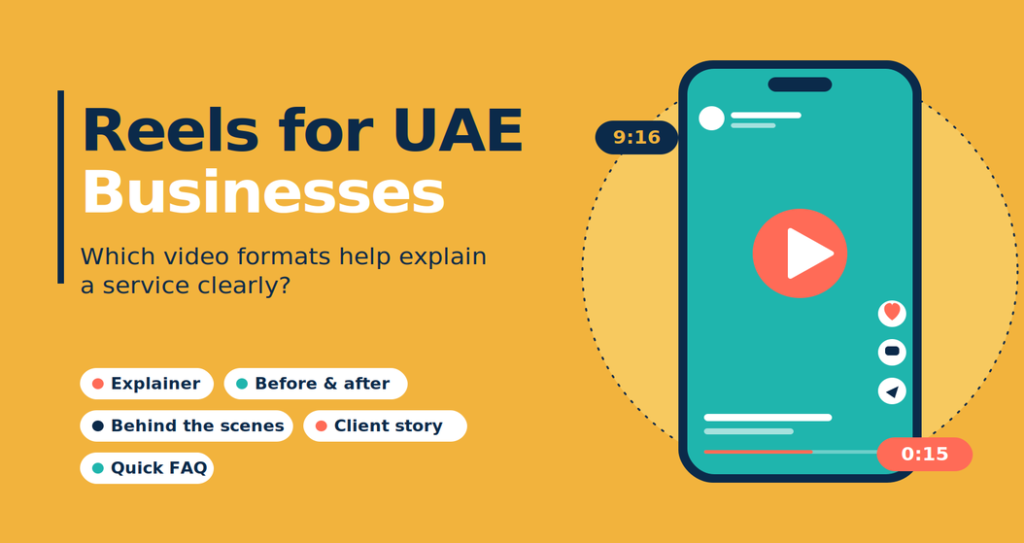
Selling a physical product on social media is relatively straightforward. A business can show the product, demonstrate how it works, compare it with another product or show it being used.
Service businesses have a different challenge.
A digital marketing agency cannot physically show SEO. A business consultant cannot put a consultation on a table. A financial services company cannot visually display a financing solution in the same way a retail business displays a product.
This is where short-form video can become particularly useful.
For UAE service businesses, Reels are not only an opportunity to attract attention. They can be used to explain complicated services in a simple way, answer common questions, demonstrate expertise and help potential clients understand what happens behind the service.
The key is choosing the right video format for the message.
A Reel does not need to be highly dramatic or follow every social media trend. If the viewer understands something useful within 20–60 seconds, the video has already served a purpose.
Why Service Businesses Need a Different Reel Strategy
A service is often intangible.
Before contacting a company, a potential client may have questions such as:
- What exactly does this service include?
- Is this service relevant to my business?
- How does the process work?
- What information or documents will I need?
- What problems can this service address?
- What should I expect after contacting the company?
- How is this different from another service?
- What should I check before choosing a provider?
A good Reel can answer one of these questions. That is much more useful than creating a video simply because “Reels get views.” For a UAE B2B company, the objective should be to make the service easier to understand.
1. The ” What is the Service?” Explainer
This is one of the simplest formats for a service business.
Choose one service that potential clients may not fully understand and explain it in plain language.
For example:
“What Is Invoice Discounting?”
The Reel could briefly explain:
- What invoice discounting means
- How it generally works
- Which businesses may consider it
- Why cash flow can be an important consideration
- What a business should evaluate before using it
A digital marketing company could create:
“What Does SEO Actually Do for a Business?”
The video could explain that SEO involves improving a website’s ability to appear for relevant searches and attracting more relevant organic visitors over time.
The important point is to avoid turning the video into a dictionary definition. Explain the concept in the context of a real business problem.
2. The Problem → Explanation → Solution Format
This format works particularly well for B2B services.
Start with a problem the audience recognises.
“Your website is getting visitors, but enquiries are still low. Why?”
Then explain one or two possible reasons.
Finally, introduce the area that may need attention.
For example:
Problem:
Visitors reach the website but do not contact the company.
Explanation:
The service page may be unclear, the call-to-action may be difficult to find, or the page may not answer the visitor’s main questions.
Solution:
Review the page structure, messaging, user journey and conversion points. This format works for many industries because it starts from the customer’s situation rather than the company’s service list.
3. The “3 Things You Should Know” Reel
This is useful when a subject is too broad for one video.
For example:
“3 Things UAE Businesses Should Check Before Running Google Ads.”
The points could be:
- Is the landing page ready?
- Is the target audience clearly defined?
- Is there a system for tracking enquiries?
“3 Things to Prepare Before Discussing Business Finance.”
The Reel can provide practical preparation points without making promises about approval, funding or timelines.
The format is simple, but the information should be specific.
Instead of saying:
“Have your documents ready.”
explain what type of information the business should organise and why it matters.
4. The Step-by-Step Process Reel
Some services seem complicated simply because the customer cannot see what happens behind the scenes.
A process Reel solves this problem.
For example:
“What Happens During an SEO Audit?”
The video could show:
- Step 1: Website crawl
- Step 2: Technical review
- Step 3: On-page analysis
- Step 4: Content and keyword review
- Step 5: Internal linking assessment
- Step 6: Prioritised recommendations
5.The “Before You Buy” Reel
This is an especially useful format for professional services.
Instead of immediately telling people to purchase your service, explain what they should consider before hiring a provider.
For example:
“Before Hiring an SEO Agency, Ask These 5 Questions.”
You could cover:
- What exactly will be included?
- How will progress be measured?
- Who will work on the account?
- How will reporting be handled?
- What information will the agency need from the business?
“Before Hiring a Website Development Company, Check These 5 Things.”
This type of content demonstrates expertise while helping the audience make a more informed decision.
It also allows your company to naturally explain how your own process works.
6.FAQ Reels
If your sales team hears the same question repeatedly, it probably deserves a Reel.
Keep one video focused on one question.
Examples:
“Do Small Businesses Need SEO?”
“Can a B2B Company Use Instagram?”
“What Is the Difference Between SEO and Google Ads?”
“Why Does a Website Need a Landing Page?”
“What Is Invoice Discounting?”
“What Information May Be Needed When Discussing Business Finance?”
Start the Reel with the actual question. That immediately tells the viewer what the video is about.
7. Myth vs Reality Reels
Many industries have misconceptions that can make useful educational content.
For example:
Myth: “SEO is just adding keywords to a website.”
Reality: SEO can involve technical optimisation, content, search intent, internal linking, website structure and other factors.
Another example:
Myth: “More website traffic automatically means more customers.”
Reality: Traffic needs to be relevant, and the website needs to make it easy for visitors to understand the service and take the next step.
The purpose is not to make exaggerated claims.
Explain the difference between a common assumption and how the subject actually works.
8. Screen-Recording Reels
Not every service Reel needs a person standing in front of the camera. Screen recordings can be highly effective for digital and technology-related services.
For example, a digital marketing company could record:
- A website audit
- Google Search Console data
- Keyword research
- A website speed test
- A campaign dashboard
- A landing page review
- A social media analytics report
9. “Behind the work” Reels
Sometimes the best way to explain a service is to show the work involved.
For example, a marketing company could record short clips of:
- Keyword research
- Content planning
- Designing creatives
- Reviewing analytics
- Building campaigns
- Team discussions
- Website testing
“What You Don’t See Behind a Digital Marketing Campaign.”
This helps potential clients understand that professional services involve research, planning, execution and monitoring—not simply posting content.
10. Comparison Reels
Comparison videos can help explain services that are often confused.
For example:
SEO vs Google Ads: What’s the Difference?
Or:
Website Development vs Website Optimisation: What Does Your Business Need?
Or:
Lead Generation vs Lead Qualification: What’s the Difference?
A useful comparison should explain the difference rather than declare one option universally better.
The right solution depends on the business objective, audience, budget, existing assets and timeframe.
That balanced approach also makes the content more credible.
11.“Who Is This Service For?” Reels
Not every service is equally relevant to every business.
A Reel can help viewers determine whether a service may be relevant to them.
For example:
“Who Can Benefit From Professional SEO Support?”
You could discuss businesses that:
- Depend on online discovery
- Operate in competitive search markets
- Have an existing website but limited organic visibility
- Want to build long-term search visibility
- Have content but lack a structured SEO approach
This helps qualify the audience instead of simply promoting the service to everyone.
12 . Case Study Reels
Case studies can turn a complicated service into a real-world story.
A simple structure is:
The challenge → What we analysed → What we changed → What happened → What other businesses can learn
For example:
“A Website Had Traffic but Limited Enquiries. Here’s What We Looked At.”
The video can explain the process without revealing confidential information. if you mention performance figures, use actual verified data.
Avoid creating artificial “before and after” numbers simply because they look good in a Reel. For B2B businesses, transparent case studies can be more valuable than exaggerated success claims.
13. Founder or Expert Explainer Reels
For professional services, sometimes the clearest format is simply having someone explain the subject.
A founder, consultant, marketing specialist or finance professional can answer one question directly.
For example:
“One mistake I often see businesses make when planning their digital marketing.”
Then explain the observation.
This can make the company feel more human and give potential clients a sense of the people behind the service.
The speaker does not need to deliver a perfectly scripted presentation.
In fact, a clear and natural explanation can often feel more credible than an overly polished advertisement.
14. Use Visuals to Explain Abstract Services
When a service is difficult to visualise, use diagrams and simple visual storytelling.
For example, instead of explaining lead generation entirely through talking-head footage, show:
Target Audience → Research → Outreach → Qualification → Follow-up → Enquiry
For SEO:
Search Query → Search Engine → Relevant Website → Organic Visit → Enquiry
For a financial service:
Business Need → Information Review → Suitable Option → Discussion With Relevant Provider
The visual structure helps viewers understand the relationship between different steps.
15. Use the First Few Seconds to Establish the Topic
A useful Reel can still fail if the viewer does not understand what it is about.
The opening should immediately establish the subject.
Instead of:
“Hi everyone, today we are going to talk about something very important…”
start with:
“Your website has traffic, but you’re not getting enquiries. Here’s one reason that can happen.”
Or:
“Considering Google Ads for your UAE business? Check these three things first.”
Or:
“Not sure what invoice discounting actually means? Here’s the simple explanation.”
The viewer should know why they should continue watching.
16. Keep One Reel Focused on One Idea
One of the most common mistakes in educational Reels is trying to explain everything at once.
A company may attempt to explain:
SEO + social media + Google Ads + website development + lead generation
in a single 45-second video.
The result is usually too much information and not enough clarity.
Instead, break the subjects into separate videos.
For example:
Reel 1: What is SEO?
Reel 2: What does technical SEO involve?
Reel 3: Why does search intent matter?
Reel 4: What should a business review before investing in SEO?
This creates a content series while allowing each video to remain focused.
17. Adapt the format to the service
Different services require different explanations.
| Service | Useful Reel formats |
| SEO | Screen recording, FAQ, process, myth vs reality |
| Google Ads | Dashboard walkthrough, checklist, mistake-based Reel |
| Social Media Marketing | Before/after strategy explanation, content process, FAQ |
| Website Development | Screen recording, process, website review |
| Business Finance | Educational explainer, checklist, FAQ |
| Lead Generation | Process, workflow, FAQ, case study |
| Corporate Banking Assistance | Preparation checklist, process explanation, FAQ |
| Branding | Before/after, design process, strategy explanation |
18 .What UAE Businesses Should Avoid
Professional service Reels can lose credibility when they rely too heavily on promotional language.
Avoid making every video about:
- We are the best”
- “Guaranteed results”
- “Get instant growth”
- “Number one service”
- “Limited-time opportunity”
- Unsupported statistics
- Unrealistic promises
A Simple Monthly Reel Structure
A UAE service business could start with a practical monthly plan such as:
Week 1 — Educational Explainer
“What Is [Service] and How Does It Work?”
Week 1 — FAQ
“Do I Need [Service] If I Already Have [Alternative]?”
Week 2 — Process
“What Happens When You Start Working With Us?”
Week 2 — Mistake
“3 Common Mistakes Businesses Make With [Topic]”
Week 3 — Checklist
“Before You Start [Activity], Check These 5 Things.”
Week 3 — Behind the Work
“What Goes Into Delivering [Service]?”
Week 4 — Industry Insight
“A Recent Development Businesses Should Know About.”
Week 4 — Case Study
“How We Approached a Common Business Challenge.”
This gives the audience different reasons to watch your content rather than seeing the same sales message repeatedly.
The Best Reel Is the One That Makes the Service Easier to Understand
A service business does not need to turn every Reel into an advertisement. The stronger approach is to use video as an explanation tool.
Frequently Asked Questions
1. Why are Reels useful for UAE service businesses?
Reels can help UAE service businesses explain services that are difficult to show visually. They can be used to answer common questions, explain processes, demonstrate expertise and help potential clients understand what a service involves.
2. What type of Reel should a service business create?
The right Reel format depends on the service and the information being explained. Useful formats include service explainers, FAQ Reels, step-by-step process videos, checklists, myth-versus-reality videos, screen recordings, comparison videos, case studies and expert explainers.
3. How long should an educational Reel be?
There is no fixed length that works for every topic. For a service business, the priority should be explaining one useful idea clearly rather than making the video longer simply to provide more information. A 20–60 second Reel can be enough to explain a focused topic.
4. Should every Reel promote a company’s service?
No. A service business does not need to turn every Reel into an advertisement. Educational, problem-solving, FAQ, process and industry-focused Reels can help the audience understand the business and its expertise before they are ready to enquire about a service.
5. How can a business choose the right Reel format for its service?
Start by identifying what the audience needs to understand. For example, an SEO service may work well with screen recordings, FAQs or process videos, while a website development service may be explained through screen recordings, website reviews or process Reels. The format should support the information being communicated rather than simply following a social media trend.
Disclaimer
This article is provided for general educational and informational purposes only. The Reel formats, examples and recommendations discussed are intended to help UAE service businesses understand how short-form video can be used to communicate their services more clearly.
The effectiveness of a particular video format can vary depending on the business, service, target audience, platform, content quality, consistency and overall marketing strategy. Social media platforms, features, algorithms and best practices may also change over time.
The examples in this article are for illustrative purposes and should be adapted to the specific needs, objectives and audience of each business. The information provided does not guarantee specific results such as views, engagement, enquiries, leads or conversions.